Friday, June 15, 2018

In 33% White New York City, the Police Department Just Admitted the Secretive Gang Database is 99% Non-White

Previously on SBPDL: In 2017 New York City, a 33% white city and President Trump's hometown, Non-Whites committed 93.1% of the murders and 97% of the nonfatal shootings


We were warned about a rising tide of color almost a century ago. 

The civilization white people built in the United States of America is now being capsized by the tide of color overwhelming the western world. [New York City’s Gang Database Is 99% People of Color, Chief of Detectives Testifies, Juvenile Justice Information Exchange, June 14, 2018]:
NEW YORK CITY — Ninety-nine percent. The number sent an audible gasp throughout the City Council chamber. Chief of Detectives Dermot F. Shea had just read off the percentage of people of color on the NYPD’s controversial — and until now — largely secretive gang database.  
The rising tide of color cometh... 99 percent of the NYPD gang database is non-white
Shea was talking publicly for the first time about one of the New York Police Department’s most popular crime-fighting tools. He testified Wednesday before the City Council’s Committee on Public Safety in the database’s first comprehensive public examination. 
Shea read the numbers from a stack of papers in front of him.  
African Americans: 65 percent. 
Non-white Hispanic: 24 percent. 
Black Hispanic: 10 percent. 
Shea said the gang database, whose number fluctuates as names are added and purged, stood at 17,441. Given those percentages, that means 17,267 of the individuals in the database are either black or Hispanic. Earlier in the morning critics rallied to protest the use of the database, saying it’s racist. 
There are 1,460 people who are younger than 18 in the database. In response to questioning, Shea said there are 17 13-year-olds, 80 14-year-olds, 204 15-year-olds, 455 16-year-olds and 704 17-year-olds. “You can see how the number goes up as they get older,” he said. The average age of someone on the database is 27, he said. 
The NYPD, which encompasses the largest detective bureau in the country, has no formal process for notifying parents whose children are in the database. But, he said, there are a number of informal ways that parents are alerted.  
“I don’t want to make it seem like there is no interaction with the parents,” Shea said. “Nothing could be further from the truth.” 
Youth officers assigned to precincts and to transit and housing units might talk to the parents during the course of an investigation and the topic might come up then.How does someone end up on the database, Public Safety Committee Chair Donovan Richards asked. 
There are a number of ways, Shea said: One is what he described as self-admission. 
This often happens on social media, where gang members may talk about their affiliation, he said. Another is through two independent sources who tell a member of the department. That name then needs to be vetted by investigators. Anyone can be a source of that information — friends, teachers, family or a confidential informant.  
Finally, he said, gang investigators can identify the presence of gang literature, tattoos, colors, clothing and other means of what they think is an indication of gang affiliation.  
The gang database was more than a bloodless policy discussion to him, Richards said: “When I was 14, I could have been in this database.”
In 2018, New York City is still a 33 percent white city.

Yet 99 percent of New York City secretive gang database is non-white.

Western civilization is drowning in a sea of color, racial groups incompatible with sustaining not only our way of life, but adhering to the standards of civilized life white people have set.

Thursday, June 14, 2018

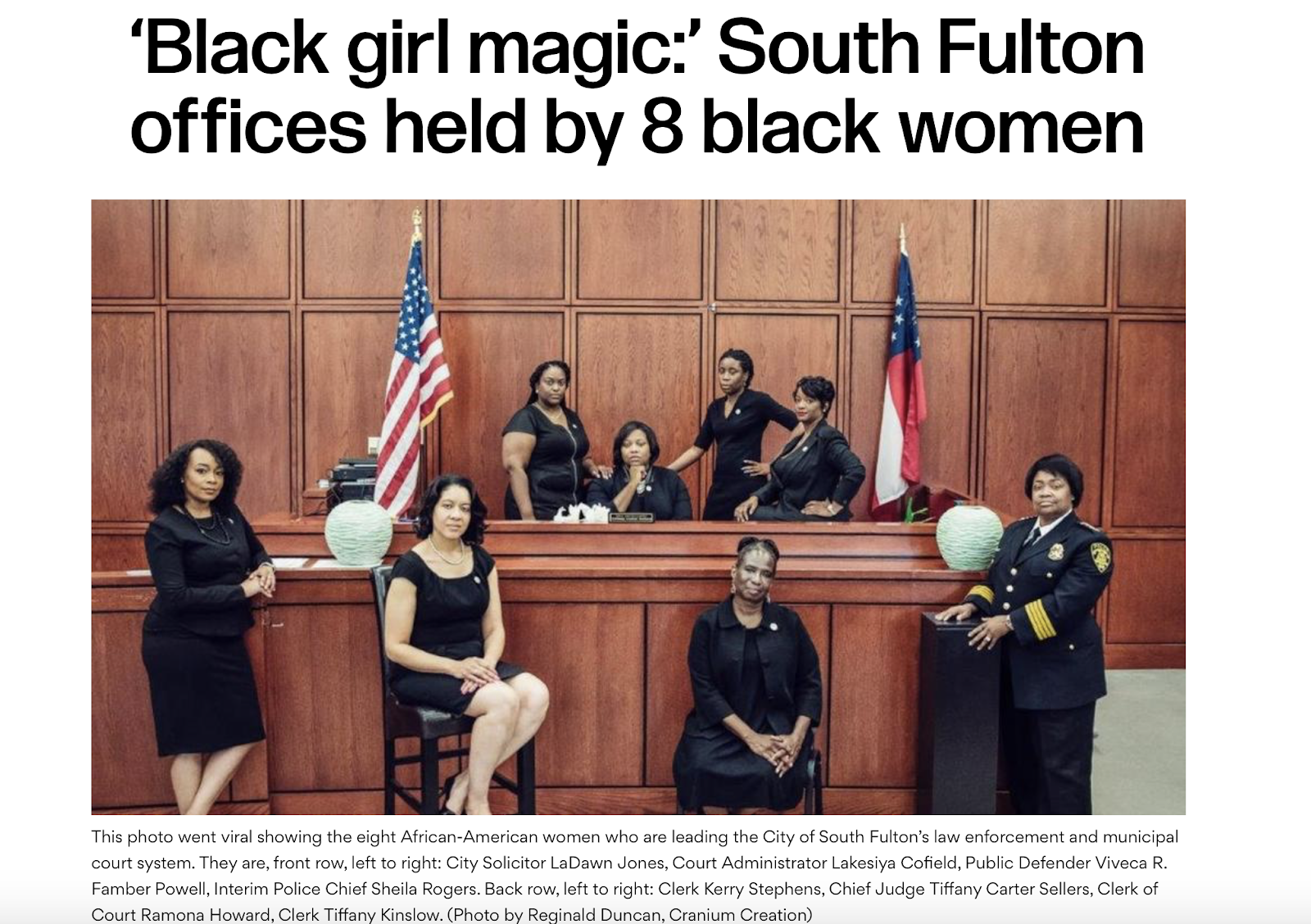
Atlanta-Journal Constitution Publishes Story Celebrating "Black Girl Magic" With Eight Black Women Holding Key Offices in South Fulton (Atlanta), a 90% Black City with High Rates of Murder, Crime, and Mayhem

Previously on SBPDL: Gas Station in 94 percent black zip code near Atlanta is bringing back full service because it's not safe to get out of your car to pump gas


Posting this story without comment, without criticism and without an ounce of hope this will turn South Fulton (the blackest part of Atlanta) into Wakanda. [‘Black girl magic’: South Fulton offices held by 8 black women, AJC.com, June 12, 2018]:
It started with a photograph. The iconic picture published by the Atlanta Voice last week showed eight African-American women — stoic, polished and dressed in black — with the wood-paneled walls of a courtroom as their backdrop. In the City of South Fulton, that is what justice looks like — a law enforcement and municipal court system that is led exclusively by black women. 
Planet of the ... Atlanta Journal Constitution celebrates the triumph of blackness and the purported magical powers of Nubian women
“I didn’t notice until (LaDawn Jones) said something … she walked in and said ‘Oh, my God! Look at all this black girl magic,’”  municipal court clerk Kerry Stephens said. 
The photo became an internet sensation almost instantly, going viral on both Instagram and Twitter. 
“I didn’t realize it was a big deal until reading the comments and hearing people say ‘Oh, someone I know doesn’t even live in the state and they saw this,’” Clerk of Court Ramona Howard said. 
Such a criminal justice system seems revolutionary in the era of the #MeToo movement and on the heels of the #BlackLivesMatter movement. But the racial and gender makeup of the team, which was brought together after a series of months-long talent searches that started last year, is a matter of happenstance. 
“It happened by accident,” said interim police chief Sheila Rogers. “It wasn’t planned. With myself and my counterparts, justice was at the top of our list.” 
Rogers is the most recent addition to South Fulton’s criminal justice leadership. She was sworn in March 5, joining the ranks of Court Administrator Lakesiya Cofield; Chief Judge Tiffany Carter Sellers; City Solicitor LaDawn Jones; Public Defender Viveca R. Famber Powell; Clerk Tiffany Kinslow; Clerk Kerry Stephens; and Clerk of Court Ramona Howard. 
It’s a seemingly rare feat. According to an American Judicature Society study, 12.6 percent of judges chosen since 2000 were minorities in 2008, and 29.2 percent of judges selected in the 21st century are were women. The Sourcebook of Criminal Justice Statistics reports that of all full-time sworn personnel in large city police departments, 16.3 percent were female and 38.1 percent were minorities. 
But what might be considered an anomaly in other cities isn’t uncommon in South Fulton, city solicitor Jones said. 
“I grew up in South Fulton. I grew up in neighborhoods where everyone around me were strong, independent, business-owning African-Americans, so black excellence is mundane to me,” she said. “ But, I recognize that this is an anomaly for other cities, and to see this many educated black women working as hard as we do is special for other little girls out there.” 
About 95,000 people live in South Fulton and nearly 90 percent are black.“Atlanta has a history of black excellence,” public defender Viveca Famber Powell said. “People routinely go to college in Atlanta — routinely pursue advanced degrees. It’s who we are.” 
Several of the women are the first person to hold their respective positions; though it is now the fifth largest city in Georgia, the southwest region of Fulton County has only been a city in name for a little over a year.
The Atlanta media can't stop celebrating blackness as some moral virtue, where any form of  whiteness is the greatest character flaw imaginable requiring immediate stamping out.

For further reading, check out this SBPDL from 2012: In the Air Tonight: White North Fulton vs. Black South Fulton County


Tuesday, June 12, 2018

In Brazil, a Nation Rapidly Losing a White Population (Replaced with Black and Brown People), Meteoric Rises in National Spending on Public Safety Met With Similar Rise in Violence


If the United States of America future is to be that of Brazil, why not take a look at the state of the latter nation in the present, so we can see a glimpse of our glorious, non-white tomorrow! [Brazil’s Spending on Public Safety Soared. So Did Violence., New York Times, June 11, 2018]:
RIO DE JANEIRO — Brazil’s homicide rate soared over the past two decades even as the state and the public sector greatly increased spending on public safety, Brazil’s government said Monday as it reported results of a rare study measuring the economic impact of violence in the country. 
Brazil in 2018 is a reminder diversity, multiculturalism, multiracialism and a declining white population is a recipe for civilizational decline at a catastrophic level
The cumulative cost of crime — including estimates of the loss of productivity and the cost of policing and incarceration — amounted to more than 4.3 percent of Brazil’s gross domestic product in 2015, the most recent year for which comprehensive data was available, according to the report. 
From 1996 to 2015, the cost of violence in Brazil rose to more than $138 billion a year, from about $54 billion, a level government officials called unsustainable at a time when several Brazilian states are unable to legally raise their spending ceiling and others are broke. 
The government put the total cost of violence during those two decades at $1.937 trillion. 
“The numbers are striking,” said Hussein Kalout, the special secretary for strategic affairs, the division of the president’s office that conducted the study. “You can’t have a prosperous society with high crime rates.” 

With 62,517 violent deaths in 2016, Brazil reached a record-high homicide rate of more than 30 per 100,000 residents, according to the latest annual study that compiles law enforcement and health statistics. (In the United States that rate dropped to five homicides per 100,000 people from eight from 1996 to 2015.) 
That study, which was released earlier this month, shows that black Brazilians make up a disproportionate and growing share of homicide victims. 
While black or mixed-race Brazilians account for just over half of the country’s roughly 205 million people, they represented about 71 percent of homicide victims in 2016. Violence was the leading cause of death for Brazilian men in their early 20s, the annual study found. 
The cost-of-violence study, for the first time, put an official price tag on a life cut short in its early stages. 
For each homicide victim between the ages of 13 and 25, Brazil lost roughly $266,000 in productivity, the government concluded. The cumulative cost of lost productivity from 1996 to 2015 — during which the number of homicides rose to 54,000 from 35,000 — was roughly $218 billion. That amounts to about four years’ worth of health care costs, the country’s largest expenditure, at last year’s level.
Diversity, multiculturalism, racial amalgamation and a declining white population doesn't exactly bring about a utopia, does it?

In the case of Brazil, we have clear-cut evidence diversity, multiculturalism, multiracialism and a declining white population is no strength, but a recipe for civilization disaster.


Monday, June 11, 2018

Washington Post Basically Blames White People for 52,175 Homicides in 50 U.S. Cities Over the Past Decade, Despite Black or Brown People Overwhelmingly Being the Suspects

The Washington Post writers who contributed to this huge story leave out one pertinent data point: the race of suspects/offenders in the 52,175 homicides in 50 U.S. cities over the past decade.

Lamenting why victims of obvious black criminality refuse to cooperate with the police (no-snitching) aside, this article attempts to place the blame for a low clearance rate on homicides squarely on white people, when in fact more than 96 percent (or perhaps higher) of these 52,175 homicides have a non-white suspect. [Where killings go unsolved: The Post has mapped more than 52,000 homicides in major American cities over the past decade and found that across the country, there are areas where murder is common but arrests are rare, Washington Post, 6-6-2018]:
The Washington Post has identified the places in dozens of American cities where murder is common but arrests are rare. These pockets of impunity were identified by obtaining and analyzing up to a decade of homicide arrest data from 50 of the nation’s largest cities. The analysis of 52,000 criminal homicides goes beyond what is known nationally about the unsolved cases, revealing block by block where police fail to catch killers.
In 50 U.S. cities, 52,175 homicides occurred over the past decade. The Washington Post refuses to acknowledge who is committing the homicides (black or brown people), but finds a way to blame white people for the violence and low clearance rates...
The overall homicide arrest rate in the 50 cities is 49 percent, but in these areas of impunity, police make arrests less than 33 percent of the time. Despite a nationwide drop in violence to historic lows, 34 of the 50 cities have a lower homicide arrest rate now than a decade ago. 
Some cities, such as Baltimore and Chicago, solve so few homicides that vast areas stretching for miles experience hundreds of homicides with virtually no arrests. In other places, such as Atlanta, police manage to make arrests in a majority of homicides — even those that occur in the city’s most violent areas. 
Police blame the failure to solve homicides in these places on insufficient resources and poor relationships with residents, especially in areas that grapple with drug and gang activity where potential witnesses fear retaliation. But families of those killed, and even some officers, say the fault rests with apathetic police departments. All agree that the unsolved killings perpetuate cycles of violence in low-arrest areas.Detectives said they cannot solve homicides without community cooperation, which makes it almost impossible to close cases in areas where residents already distrust police. As a result, distrust deepens and killers remain on the street with no deterrent. 
“If these cases go unsolved, it has the potential to send the message to our community that we don’t care,” said Oakland police Capt. Roland Holmgren, who leads the department’s criminal investigation division. That city has two zones where unsolved homicides are clustered.  
Homicide arrest rates vary widely when examined by the race of the victim: An arrest was made in 63 percent of the killings of white victims, compared with 48 percent of killings of Latino victims and 46 percent of the killings of black victims. Almost all of the low-arrest zones are home primarily to low-income black residents.
In a country where western civilization is waning, and white people have ceded all moral authority to a black Marxist's "judging by content of character instead of color of skin" dream, we can only watch helplessly as our greatest cities are veritable war zones where black and brown people kill one another over errant glances, single digit debts, and disrespect.

Woe to those white people economically left behind enemy lines when their property values depreciate and they can join the white flight out of formerly prosperous, all-white communities now enriched with bellicose non-whites.

Understand in the rules of Black-Run America (BRA), every inconvenience black people face - and increasingly brown people - is the fault of relentless, brutal, exacting white racism or the residue of a white supremacist power structure.

The ghost of Jim Crow is compelling black people to not only murder other black people, but silencing blacks from speaking to the police about who committed the atrocity.