|
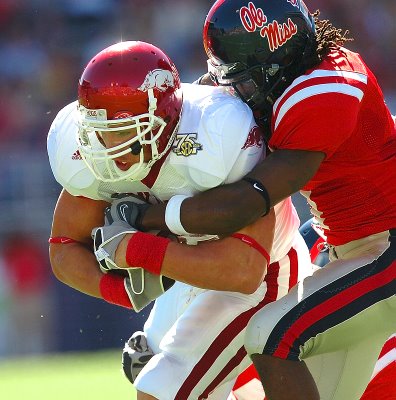
| "White boys" like former Arkansas running back Peyton Hillis aren't supposed to play in the SEC |
We all have things that interest us in life. For me, my most poignant memories will always center around football. Whether it involves going to college football games to tailgate with family and friends, playing the game, or watching my alma mater, nothing beats fall Saturday's.
Nothing.
Being relatively young, I was born years after the Southeastern Conference (SEC) teams finally integrated. At first, the quality and character of the Black student-athlete recruited was quite high, but this mindset evaporated quickly to the point where SEC schools now recruit Black athlete-students who barely qualify for admission to the schools (
South Carolina head coach Steve Spurrier complained about admission requirements keeping out talented Black athletes) that are in the conference.
Sports Illustrated published an article in 1991 that bragged how Black people now dominated the SEC. Here are some excerpts
from that story:
Even now he has vivid memories of games at Auburn, where the kindest chant was "Char-coal, char-coal," and of games at Mississippi, where Confederate flags were wielded with malice. Those were the most nightmarish trips for Vanderbilt's Perry Wallace, who in the winter of 1967-68 became the Southeastern Conference's first black varsity basketball player. He tried to block out the jeers, the taunts and the slurs, but sometimes it was impossible. Sometimes his palms would get so sweaty that a pass would slip through his hands, or he would get so jittery that he would have to go to the bench amid hoots of derision.
"Those were scary, scary situations," says Wallace, now an attorney in Washington, D.C., and a law professor at Baltimore University. "Every time we had a road trip, I approached it with the deepest sense of dread."
Today that all seems so long ago and so strange. Indeed, no league in the nation has benefited more from integration—check out all those postseason bowl and NCAA basketball invitations—than the SEC, which fought it the hardest. This season the conference's football teams are 57% black, its basketball teams 64%.
The SEC has been enriched by so many outstanding black athletes—names like Herschel Walker, Bo Jackson and Charles Barkley leap to mind—that it is difficult to remember that when Wallace made his debut for Vandy, the threat of violence was as real and near as the redneck hecklers sitting just behind the benches. David Sansing, a professor of history at Mississippi, remembers those times when he listens to the current debate on campus over the Alumni Association's request to Ole Miss fans not to wave Confederate flags at athletic events because doing so is an insult to blacks. "When you get down to it," says Sansing, "white Southerners and black Southerners still live in a world apart from each other, but it's better, and athletics has been a part of it. Take this flag thing. Twenty-five or 30 years ago, a white man could literally kill a black person in Mississippi without much fear of reprisal. Now we're talking about being insensitive to the feelings of blacks and scolding people for it. That's a hell of a difference."
The South was a racial battleground all through the 1960s, and its collegiate athletic teams, the most visible symbols of both the region's pride and its prejudice, were caught up in the emotions. Somehow, breaking the color barrier wasn't as difficult in the SEC's neighboring leagues, the Atlantic Coast and Southwest conferences, perhaps because Dr. Martin Luther King Jr. and the other civil rights leaders chose to fight in the heart of Dixie. The ACC was quietly integrated by Maryland, where the pioneers were football player Darryl Hill in 1963 and basketball player Billy Jones in '66. Nor was there much of a stir in the SWC when Texas Christian's James Cash became its first black basketball player in 1965 and Baylor's John Westbrook became the league's first black football player a year later.
What's funny is that now white people get jitters when they drive into Atlanta, Birmingham, Montgomery, Jackson (Mississippi), Memphis, Knoxville, Columbia, Tallahassee, the wrong parts of Tuscaloosa, New Orleans, Baton Rouge, and other Southern cities because Black people make them unsafe.
Sadly, it is the sons of these Black people that SEC (and ACC, Big East and other college football conferences) schools recruit with reckless abandon - many times going on probation for cheating during the recruiting process - though they have no desire to interact with these Black people outside of football Saturday's.
We have pointed that
college baseball is more in line with the racial breakdown of SEC student enrollment, with white players comprising the bulk of the rosters. However, college football is the exact opposite. The University of Mississippi
Rebels Brown Bears have thrown away all of their traditions (
read this article by me at Alternative Right on the situation) in the vain pursuit of landing Black athlete-students to lead them back to the glory days of Rebel football -- when the team was all-white and actually won games.
The University of Mississippi has a student body population that is
82 percent white and 13 percent Black, but will see only four white players start on the football this season (out of 22 positions - 11 on offense and 11 on defense). The rest of the teams in the SEC are just as white - in terms of student body - but some are even worse when it comes to the football players. Here is Caste Football with a breakdown of the 2011 starters for the
12 SEC teams compared to the Mountain West Conference:
One way to see how Southern teams discriminate against White athletes more than any other conference in the country is to compare the darkest conference in the country, the SEC, with the Whitest conference in the country, the MWC. Even the high black populations in the states of the Old South don’t account for or excuse this extreme level of anti-white discrimination. Shown below are the number of White starters for each team.
SEC
Vanderbilt-9/22
Kentucky-8/22
Auburn-6/22
Alabama-5/22
Arkansas-5/22
LSU-4/22
Ole Miss-4/22
Tennessee-4/22
South Carolina-3/22
Georgia-2/22
Mississippi-2/22
Floirda-1/22
Total of 53/264 (20.08%) in the SEC
MWC
Boise State-16/22
Air Force-15/22
Wyoming-15/22
San Diego State-12/22
Colorado State-10/22
Texas Christian-10/22
New Mexico-7/22
UNLV-5/22
Total of 90/176 (51.14%) in the MWC
I pointed out in an article called
The Opiate of America that the bulk of Black athlete-students enrolled at major colleges and universities would never have qualified and received special admission wavers were they not athletes. The reality of that statement is going to become increasingly clear this week during our college football preview.
I've thought a lot about this quote from 1955 that will be quoted below and I have finally realized I agree with it. Completely. This is from
Time magazine:
Two thousand students from the Georgia Institute of Technology stormed through Atlanta one night last week, whooping up and down Peachtree Street, pushing aside troopers who tried to bar their way, and generally raising hell. At the State Capitol, the boys pulled fire hoses from their racks, adorned the sculpt head of Civil War Hero John Gordon with an ashcan. A dozen effigies of Governor Marvin Griffin were hanged and burned during the students' march, which culminated in a 2 a.m. riot in front of the governor's mansion.
Earlier in the day, the governor had incurred their wrath by a pinhead act: he asked the State Board of Regents to forbid the athletic teams of the university system of Georgia (e.g., Georgia Tech, the University of Georgia) from participating in games against any team with Negro players, or even playing in any stadium where unsegregated audiences breathed the same air.
"The South stands at Armageddon," brayed Griffin to the regents. "The battle is joined. We cannot make the slightest concession to the enemy in this dark and lamentable hour of struggle. There is no more difference in compromising the integrity of race on the playing field than in doing so in the classrooms. One break in the dike and the relentless seas will rush in and destroy us."*
The governor had a specific game in mind: Georgia Tech had contracted to play the University of Pittsburgh in New Orleans' Sugar Bowl on Jan. 2. Pitt has been selling its block of tickets on a desegregated basis, and Bobby Grier, a Pitt reserve fullback, is a Negro.
Judging by the current state of Atlanta, Memphis, Birmingham and hundreds of other southern cities and counties (not to mention American cities like Philadelphia, Baltimore, Detroit, St. Louis, Cincinnati, Milwaukee, Cleveland, Buffalo, etc.), the dike burst everywhere in this once great nation.
All of these cities are awash in Black crime, with abandoned and devalued property (both residential and commercial), empty business districts, and lush in potential Black recruits to fill the rosters of SEC teams. White people do everything to avoid Black people, save when it comes to filling roster spots on their beloved alma maters football squad.
I've read more books and articles on the history of college football and the illustrious histories of the storied programs then I care to admit. This week, I will preview each of the SEC teams (basically, a racial history of the team, the school, etc.), plus I will discuss Notre Dame, Brigham Young University, Boise State, the University of Wyoming, the University of Washington, Georgia Tech, Ohio State University, and the University of Texas.
It's going to be the most radical week ever at SBPDL. It might not be for every regular reader, but you learn more about why we live in Black-Run America (BRA) this week then all prior 130 weeks combined.
Fitting, the University of Georgia and the University of Ole Miss both open up their 2011 schedules against teams sporting majority white starting lineups. Just like when an integrated Southern California came to play a lily-white Alabama (and out-manned Crimson Tide team) in 1970 and won convincingly - though BAMA would win the next year with only two Black players against that same USC team - in Birmingham, Boise State and Brigham Young University have the opportunity to show that white boys can win in the south in sports outside of baseball.
BYU represents what all colleges and universities in America once looked like, sporting an
Honor Code (that Black people hate) and
sports programs that are majority white and reflect the majority of the students. Certainly, BYU represents what the SEC schools all looked as late as 1971.
Just as BYU basketball star Jimmer Fredette was made fun of for being a white boy competing in the Black world of basketball, BYU football players have received scorn from
Sports Illustrated and other outlets for playing white boys.
Daniel Sorensen, the starting strong safety for BYU, dared to point out that a bunch of white boys from Provo are getting ready to head to Oxford - he didn't state that the crowd will be 99 percent white - and play a team of largely unqualified Black athletes. Read
The Blind Side by Michael Lewis or
Meat Market to learn about the academic titans Ole Miss recruits. Here's what Sorenson said to the
Daily Herald:
"The purpose of BYU, why we're here and why we're playing – and where we're trying to go with this program. It kind of fires you up. It kind of gets you excited.
"To go out there and play for a specific purpose of showing people that we're playing for more than football. This is a faith-based university and we're trying to represent that. The players, and the flag bearers.
"What if we go out there and dominate (at Ole Miss, Sept. 3) and people start seeing us? And they put us on the map, and we're on ESPN. And they start wondering who these kids are – what are they doing with their lives, and why are they so good?
"And maybe a bunch of white boys out there go down and beat up on an SEC team, a big, physical team like (Ole Miss). If we go in there and dominate, what does that say? It starts raising questions and curiosity.
"It starts making things interesting. Getting the pot stirred, and what not. Shoot, that's fun. That's what we're out here to do. We're out here to turn heads. We're out here to change the norm of BYU and what people think of us.
"I would like to see people start fearing us. I don't know. Kind of looking at BYU as a dominant team. Especially the defense. Nobody is going to want to run against us. Start setting that respect
"This is exciting. I can't wait to go down to Ole Miss."
"White boys." What a seditious statement! How dare someone notices that BYU is predominately white (one of the most monochromatic teams in all of college football as Sports Illustrated called them), especially a lily-white player like Sorensen!
The SEC is perceived, by the entire country, as a Black conference, though Black males probably make up less than 2 percent of the enrollment of each of the 12 schools general student body population. They just don't have the grades to get in, unless the standards and qualifications for enrollment are lowered.
Remember that current San Diego Chargers tail back and LSU legend Jacob Hester fought massive discrimination from predominately Black
SEC defenses back in 2007:
The Air Force Academy fields one of the whitest teams in college football because few Black males have the academic qualifications, and high enough SAT/ACT scores to garner an appointment or scholarship there, or the dedication to stay the whole four years (if you leave the AF Academy after two years there, you owe the government your tuition back).
Peyton Hillis, a University of Arkansas graduate, faced (faces) the same type of discrimination from predominately
Black NFL defenses.
For daring to say "white boys"
Sorenson has been blasted in the media. It's not like he called himself a "fucking soldier" like Black University of Miami tight end Kellen Winslow did in the early 2000s.
Jason Franchuk, who wrote the piece with the quoted "white boys" statement, had this to say in a
subsequent article:
Readers that wrote me directly apparently cringed at the quote and weren't thrilled with Sorensen's choice of words. They also admonished me to "be more careful" next time.
Here's part of my response to one reader:
However, I think Daniel's words were a lot more passionate -- and
not really offensive. He spoke from the heart about his excitement
for this season. What he believes the team can accomplish for
itself, and for the school. As for the "white guys" comment -- I
wasn't printing it to produce controversy. Let's face it, fair or
unfair, there are some absurd stereotypes in sports. Daniel, I
think, wants to break them down. Why is it that, even in BYU's best
recent years (or Air Force for that matter), "team speed" is never
one of their strengths? Why is it that Ole Miss absolutely has to
automatically have that advantage? I don't think Daniel believes
HIS team is "just a bunch of white guys." I think he, and
teammates, recognize that's the view point from the National
General Audience (at this point). Going to Ole Miss, SEC Country,
to start the season on ESPN -- I think he is giddy at the
possibilities of breaking that down. I thought the words were
earnest and passionate. Frankly, I'm surprised they're causing such
a uproar of racism. He's not a racist. Just a passionate,
happy-go-lucky kid who wants to show the world that he believes BYU
is really, really good on any level of distinction.
 |
| BYU is a predominately "white boy" team |
Having more "team speed" is
how people always describe the SEC, because it has more Black players. The perception being that whites are slower and not as athletic. Why is it that so few
Black athlete-students graduate from college again? There was a day when white student-athletes from Auburn, Alabama, the University of Georgia, Ole Miss, Mississippi State, Florida, Tennessee, Vanderbilt, Louisiana State, and Kentucky would go on to be doctors, lawyers, or prominent businessmen. A time when the legendary coaches like Shug Jordan, Vince Dooley and Bear Bryant were trying to not only win, but shape and mold future community leaders as well.
Journalists and sports pundits alike have criticized, analyzed and hypothesized about why the system of college sports is breaking down at length in the past week. But we've been ignoring a big black elephant in the room.
High profile football players caught in the center of booster controversies are disproportionately African American.
USC's Reggie Bush, Oklahoma State's Dez Bryant, Georgia's A.J. Green, Alabama's Marcell Dareus, Auburn's Cam Newton and the latest poster child of "amorality" in sports, Terrelle Pryor of Ohio State, have all become infamous for proven — or sometimes unproven — cases of having friends with benefits.

We've seen public disgust directed at these athletes and now even NFL commissioner Roger Goodell is exposing his frustration with NCAA rule-breaking by punishing Pryor with a five-game suspension.
Oddly, Goodell didn't share this same outrage against Pete Carroll when he bolted out of USC's embattled football program to the Seattle Seahawks last year.
Black athletes who break the rules are more likely to face a harsher judgment in the court of public opinion or — even worse — Goodell's court. The facilitators of cheating, many of whom happen to be white, move on to NFL jobs or cushy TV jobs with significantly less criticism.
I have to wonder, does this discrepancy represent an underlying prejudiced attitude towards African-American athletes?
Contrary to popular belief, African-American men don't make up the majority of college athletes. According to the 2009-10 study from the Institute for Diversity and Ethics in Sports, black men made up just 24.9 percent of all college male athletes.
Equally interesting is the fact that black male athletes don't even comprise an overwhelming majority of Division I football players. Until last year, white athletes made up the majority of college football players since the 1999-2000 season. Black and white athletes currently share near equal representation at 45 percent, with African-Americans holding a slight edge at 45.8 to 45.1 percent.
I don't believe high profile black athletes are the only group of rule-breakers. I do believe they're more likely to get caught.
Given the string of high profile cases involving black football players, I spent hours conducting research, speaking with multiple sociologists, a former USC linebacker and even a college runner to determine if African-Americans really are breaking the rules more and if so why.
Ramogi Huma, president of the National College Players Association and a former linebacker at USC, summed up the questions best.
Cheating often takes place behind closed doors so it's impossible to determine who is doing what.
"You only know what comes out," he said.
It's not a stretch, however, to believe black athletes are targeted more by rogue agents, boosters and runners. Black athletes in skill positions like wide receivers, running backs and — in the modern era of college sports — quarterbacks are more lucrative and visible, which translates to greater opportunity for temptation.
Race aside, there is a long history of high-profile athletes receiving and asking for benefits. Most of them see this as an act of rebellion against a college system producing millions on their likeness and image.
But, as proven, this type of rule-breaking doesn't bode well for the image of black athletes.
"I think there does tend to be a perception that African-American athletes and African-Americans in general are more prone to criminal behavior and that might encourage certain individuals to approach them and perhaps not approach other athletes," said Timothy Davis, a law professor at Wake Forrest University who has authored several books about sports, business and race.
I cringed when hearing that one of the United Kingdom's largest media providers, British Broadcasting Corporation, allowed guest analyst David Starkey to go unchallenged on his thought that "whites have become blacks" in reference to the disposition of rioters in London.
The inference here, of course, is that black people symbolize deliquency. Apparently, some of those rioters had been infected with "blackness."
As I see one high-profile athlete after another vilified for rule-breaking, I wonder if this same perspective about deliquency and blackness is being applied to college football.
I'm not condoning cheating, but I do hope the attitude towards corruption in college sports is not black and white.
It's not "white boys" getting into trouble (and if they do, normally a bunch of Black guys got them in trouble like at Auburn and LSU recently), but it is white boys keeping those graduation rates up.
"White boys", Armageddon, and sports; it all comes down to college football being the tool that allowed Birmingham, Atlanta, Memphis, Columbia, and hundreds of other southern cities and counties to be completely turned over to the Black Undertow and corrupt Black city leaders and their Disingenuous White Liberal (DWL) enablers.
When Boise State plays UGA this coming Saturday in Atlanta at the Georgia Dome and BYU kicks-off against the Mississippi Black Bears from Oxford, remember that Boise State and BYU reflect what SEC football teams should look like.
As you'll learn this week at SBPDL: very few, VERY FEW of the Black athletes receiving free tuition to SEC schools have the grades or academic qualifications necessary for enrollment, especially at a school like UGA.