Showing posts with label christmas. Show all posts

Friday, December 25, 2009

The Sixth Day of Christmas at SBPDL - Traditional Views of Santa Claus


Black people have a lot to be thankful for in the United States this magical Christmas Day. Sadly, for Black children around the nation - of whom more than 70 percent are born out of wedlock - they were visited last night by a large, fat, jolly white man bringing toys and goodies for good little boys and girls.

No, we aren't talking about the family that adopted Michael Oher, nor the many white families that adopt Black babies... we are talking about Santa Claus, that incredibly talented white man who lives in the North Pole and, with the incredible dexterity of his many elves and 9 reindeer, visits the homes of children and bestows upon them gifts for them to open on the 25 of December:

"Santa Claus, also known as Saint Nicholas, Sinterklaas, Father Christmas, Kris Kringle or simply "Santa", is a legendary figure who, in many Western cultures, brings gifts to the homes of the good children during the late evening and overnight hours of Christmas Eve, December 24 or on his Feast Day, December 6 (Saint Nicholas Day).[ The legend may have part of its basis in hagiographical tales concerning the historical figure of gift giver Saint Nicholas. A nearly identical story is attributed by Greek and Byzantine folklore to Basil of Caesarea. Basil's feast day on January 1 is considered the time of exchanging gifts in Greece.

While Saint Nicholas was originally portrayed wearing bishop's robes, today Santa Claus is generally depicted as a plump, jolly, white-bearded man wearing a red coat with white collar and cuffs, white-cuffed red trousers, and black leather belt and boots. This image became popular in the United States and Canada in the 19th century due to the significant influence of caricaturist and political cartoonist Thomas Nast."
Basically, the entire history of Santa Claus is covered in the heritage of a Western European blanket and good ole Santa is a gift-giving, corpulent white guy, capable of delivering smiles and joy to kids of all races - as long as they haven't been naughty.

What compels this altruistic turgid white guy to dedicate his entire life to bringing joy and happiness to young people? Why invest so heavily in hoping to brighten kids lives with presents under the tree and stuffed stockings of candy and toys?

Well, some Black people find this notion of a bovine white dude watching them 24/7 to be a tad overbearing and encroaching on their personal freedom, if not down right racist. The fact that he watches white kids 24/7, notwithstanding, Santa Claus is viewed by Black people as the embodiment of George Orwell's Big Brother.

Worse, some Black people have the audacity to declare Santa an unreal entity:
"Back in September, Newsweek featured an article titled “Even Babies Discriminate“. Mandy beat me to the punch and blogged about it. However, what I wanted to blog about could wait, until now.

Towards the end of the article, we learn that teachers in a rural Ohio school read a version of ‘Twas the Night Before Christmas in which Santa is black. They introduced the concept of Santa as a black man. At the school Christmas party, Santa showed up, and yes, he was black.

The problem is, Santa isn’t black. You know why?

Santa Claus isn’t real.

I love ‘Twas the Night Before Christmas. I love Christmas in general. I watched Frosty the Snowman three times tonight. None of that changes the fact that Santa Claus is a fictional character. We don’t “do” Santa in our house. Jack is told that he is “pretend”, like the Disney Princesses and Lightning McQueen. Does he understand that? I don’t know. But I know he won’t be getting any presents from Santa, and that we do not encourage the Santa myth at all.

Now, I know that other parents like pretending Santa is real, and that’s OK, I suppose. My beef, and the reason for writing this post, is that a school was essentially teaching kids that Santa is real. Not only that, but they were teaching kids that this fictional character is black. So, then, the kids grow up, find out Santa Claus is a sham, and these kids who were so happy to learn that Santa is brown like them are doubly upset."

Thankfully, this view is in the clear minority, for most Black people believe in Santa Claus and more importantly, have created the myth of Santa Claus being an obese Black guy:
"And for me Santa Claus always was, is now, and always will be a black man.

Part of my investment in Santa's blackness derives from my personal biography. My father is a brown-skinned man who smokes a pipe and has had a full beard of gray hair since my infancy. Black Santa looks like my dad, so I am drawn to him. But my father is nothing like a jolly elf. Professor Harris is a stern disciplinarian and a politically engaged intellectual. I can't imagine anyone less likely to hang out with toy-building magical creatures while wearing a fur-trimmed red suit.

My attachment to black Santa is rooted in a fierce racial consciousness I have nurtured since childhood. In my adulthood I have revised much of my unthinking, black nationalist assumptions. My feminist commitments, interracial political work, and emerging cosmopolitan sensibilities make me somewhat less likely to exercise an automatic preferential option for blackness. This journey of political consciousness is also reflected in my holiday choices.

As a kid, black Santa represented a benevolent spirit of goodness and kindness directed toward African American children. Black Santa cared about little girls who look like me. I did not need blue eyes or blond ringlet curls for black Santa to find me adorable. Black Santa did not put a blond baby doll under my tree. He knew that I needed to rock, hold and nurture a baby doll with brown skin and kinky hair. Black Santa expected Nat King Cole to be playing on the stereo when he arrived on Christmas Eve.

Symbols matter. They help shape our understanding of national culture and identity. A president is not a country, but he embodies the national identity. Santa is the secular, commercial symbol of a religious holiday, but he nonetheless embodies the popular imagination of the holiday.

It is time for Americans to get comfortable with black Santa."

Yes, even though Santa Claus is a myth from the cold environment of Western Europe (and the marketing gurus of Madison Avenue) a rewrite is in order to ensure that Santa Claus embodies the new Black World that we all live in currently, to placate the national identity that is being forged, for we no longer live in Pre-Obama America.

Anything white that reminds people of The Greatest Generation must be replaced with a prominent Black face and Santa Claus is a symbol of ethnocentrism so pervasive that Black children find the image of a Black Santa as alien as white people do:

"In keeping with that spirit of diversity, several dozen families attended a recent holiday party at the West Medford Community Center, where an African-American Santa fielded toy requests from tiny tots while handing out candy canes. Cosponsored by the New England Alliance of Multiracial Families, the event, the 11th to feature a Santa Claus of color, attracted parents and children for whom encountering a black Santa (with a white Mrs. Claus standing alongside him) was not just a curiosity but a priority.

Deleatra Bolton of Malden, accompanied by her husband and two young children, said it was refreshing to find a "nontraditional" Santa in a state like Massachusetts, where such sightings tend to be rare. In Maryland, the state she'd lived in previously, black Santas are far more commonplace than up North, Bolton said.

"In our house at Christmas, all the angels and Santas are black," Bolton said over the fa-la-la of holiday music emanating from a boombox. "My daughter is 4 and just starting to realize about race." This year, she said, her daughter had wondered aloud why there was a black Santa at home and a white Santa at the mall. "I told her that Santa can change his color depending on whichever house he visits, and that what's important about Santa is what's on the inside, not the outside," Bolton said with a smile."

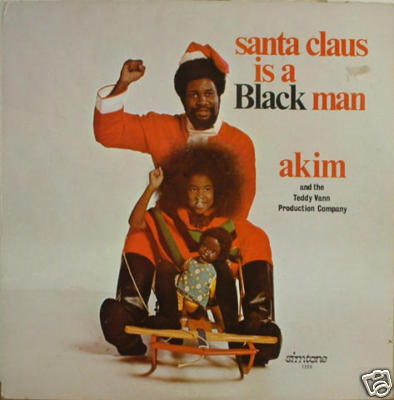
Santa Claus is a paragon of virtue, kindness and sharing and for these traits to be synonymous with a fat, bearded, white guy is not only racist and vile, but insulting to Black people who hope to remake Santa in the image of a Black man once and for all. White people can't have any positive symbols anymore to share with the world and culturally speaking, Santa Claus must be recast as a Tyler Perry character in the hopes of forever placing a Black man squarely in the residence of the North Pole once and for all.

Santa Claus was once a white gentlemen, who had consumed quite a few to many meals and became the portly, lovably benevolent septuagenarian who all children love to visit at the mall and then impart upon him their most coveted secrets: what they want for Christmas.

For Black children to continue to be told that only a white person can grant them these wishes on Christmas Day reinforces negative stereotypes about the patriarch role of the white man as being forever the protector of Black people:

"Students at St. Stephen Elementary School found out last week that Santa Claus can have the same skin color as them.

That's because two Santa Clauses — one white, one black — were invited to the rural Berkeley County school at separate times last Friday to take pictures with students of the same skin color.

Principal Willa Norton's decision to invite two Santas has drawn criticism from a few parents and from two civil rights organizations, which said the school shouldn't have divided the students by race without asking parents first.

Marguerite Lyons, who found out about the two Santas while picking up her son outside the school Thursday, said dividing the children by race smacked of prejudice. All the children should have seen one Santa, she said.

"I don't care if (Santa) was Chinese or Puerto Rican," said Lyons, who is black. "Everyone's the same."

Norton said everything was done to benefit a student population that is predominantly black and from low-income families. More than 97 percent qualify for free or reduced lunch, and 75 percent are black.

She said most of the children probably wouldn't have a chance to meet Santa otherwise, and she wanted to use the opportunity to let students know that the possibilities are endless.

"It was just an opportunity for my kids to be exposed to a Santa who looks like them," said Norton, who is black. "I just want my kids to know that everyone can do all kinds of things."

She said she even tried to find a Hispanic Santa for the handful of Hispanic children and an Asian Santa Claus for the school's one Asian child.

Parent Jay Paulin, who is black, said he liked that his daughter and the other children could talk and take pictures with a black Santa.

"It shows (Santa) can look like them too," Paulin said.

Norton said she told all of the 489 children that the Santas they met weren't the real Santa, just his helpers who agreed to take pictures while the real one prepared for Christmas."

No, the end of Santa Claus' reign as a white man incapable of hitting the gym is upon us and the correct and racially sensitive image of Santa Claus as a Black person is soon to be the norm in the United States of America. Whiteness is the first causality of diversity and Santa Claus' traditional whiteness must go. He - as an obese white man - is a callous example of cultural imperialism by white people upon the colored masses of the nation.

The end of the white Santa Claus is nigh, and this occurrence couldn't come soon enough for Black people, who have put up with a dominant white culture for far too long:

ATLANTA -- The man in the big chair taking Christmas requests at The Mall at Stonecrest might not fit the image most Americans have of Santa Claus. Though he has a beard, wears a red velvet suit and is pleasantly plump, this St. Nick is African-American.

Two years ago, during the first Christmas season at the newly opened mall in Lithonia, a suburb east of Atlanta, a white Santa was on hand to grant holiday wishes. Then requests started pouring in from African-Americans who said they wanted a Santa their children could relate to. Before long, there were two Santas at the mall, one black and one white.

"They had to try and meet the needs of their clientele, about an equal mixture of African-Americans and whites. I think they are doing that real well by offering both," said Myron Mills, 41, the black Santa who greets children on weekend evenings. "In addition to that, we have put a spin on it. I'm also a unique Santa because I sing."

Like Stonecrest, suburban shopping malls across the country have had to address the issue of diversity during the holiday season. Not only does it apply to Santa's skin color, but it means offering black-theme holiday cards in the Hallmark store, stocking Hispanic-looking dolls in toy shops and selling ethnic designed tree ornaments from carts in the mall hallways.

While African-American community groups and churches in many urban areas have long provided black Santas for children to visit, suburban malls -- where Santa is often the major attraction during the holidays -- often have not, despite efforts dating back to the civil rights era. In the 1960s, for example, the Southern Christian Leadership Conference boycotted Federated Department Stores to get them to hire a black Santa in Cincinnati.

While resistance to the idea remains in some places, diversity has gained support in recent years.

"As people become more culturally sensitive, we are beginning to see more diversity in icons such as Santa Claus. It is becoming more prevalent because America is experiencing a clashing of cultures and a transition," said Deborah Williams, a diversity consultant at Leadership Edge Management Consultants in Atlanta.

"It is difficult because our society has traditionally been based on white dominance. But in this evolution, the needs of changing communities will have to be addressed. And over time, people will become more comfortable with two Santas, a black Santa or one of another ethnicity."


For 9-year-old Zachary Kimmel, a white child who was waiting in line, there is no reasonable explanation for two Santas.

"It's freaky," said the third-grader, who lives in Conyers. "I don't get it because it doesn't keep with the legend of Santa Claus. Everybody knows Santa Claus is white."

His mother, Angie Venham, 35, said she made a conscious decision to come to the mall when the white Santa was on duty.

"There is nothing wrong with people having a selection so they can choose the one they want," she said. "We just wanted to keep down the confusion. You heard the boy."

Jack Greene, 69, a white who is working his 12th year as a Santa and his third at Stonecrest, said he has not noticed a difference in the preference of black and white families.

"Black people don't seem to care that much whether Santa is black or white. I have just as many black kids as white," said Greene. "In fact, some of the black people have said they prefer a white Santa."

Mills, the African-American Santa, said about 95 percent of the children he sees are black or Hispanic."
Santa Claus' days a white guy are numbered, and for many this moment couldn't come soon enough:

"Like shopping for gifts then wrapping them up, some Christmas traditions rarely change. But there's one classic image of the holiday season that seems to be changing color. Still, true believers don't seem to mind.

Black Santas in predominantly African-American neighborhoods have become a regular thing for the holiday season, but lately we see more and more in areas that are mostly non-black.

"Santa is so symbolic in these times and a Santa is a Santa. Kids see no color they just see Santa and they know who he is and they know what he stands for," said Carlton Benjamin, a professional Santa Claus.

Greenpoint, Brooklyn is known as New York City's polish enclave. Yet black Santa is a hit.

Barry Perlmutter owns a company that is a Santa agency of sorts with a multi-cultural crew of Santas ready to be dispatched to any venue in need of a freelance Father Christmas.

Perlmutter said, "I might hear from an adult, not really a child: 'Oh, that's a black Santa or sometimes we have a Spanish Santa and the adults more than the children might feel a little weird, but I want to make sure that we have a diversified group of Santa Clauses that can go anywhere anytime and make everybody happy."

And everybody's happy here at a store in the suburban town of Bay Shore, New York where customers are predominantly white, but their Santa is black -- and good for business, too.

For some kids in this suburban neighborhood, it didn't even occur to them that Santa is black. When asked if they noticed anything different about him, they struggled to find an answer.

But some of the older children did notice something was a bit different.

"He's black," said 9-year-old Michael."

Black Santa toys and decorations are big sells in the Black community and make economic sense for those companies deciding that 13 percent of the United States population is worth placating with merchandise.

Stuff Black People Don't Like includes the traditional views of Santa Claus, even though the myth of a magnanimous elderly individual who bestows presents to morally upright children originated in Europe. Santa - in this current era- is Black and he has a few things in common with Tiger Woods, although Santa has always stopped at three hos.

Black children - and all non-white kids - must learn that the era of white dominance is over, and with the it, the noxious notion of a white Santa Claus too.


Thursday, December 24, 2009

Merry Christmas from SBPDL


We still have a few days of The 12 Days of Christmas to post, but we wanted to take a brief moment to wish everyone reading a Merry Christmas (and pause from any new SBPDL entries).

The 25 of December is a wonderful day as family gather near, old friends call to wish you a Merry Christmas and strangers act a little nicer in an attempt to bring about the best in humanity.

Christmas is a holiday
that some believe is being devalued in the United States and turned into an increasingly secular event, as the mere mention of Jesus Christ and the celebration of his birth sends many a Grinch into fits of near spontaneous combustion.

Regardless of what you believe, Christmas has long been a source of controversy in the United States, as Puritans found the day an odious invention of the Catholics and modern Scrooges find the celebration of Christmas an affront to the only Holy Ghost worthy of praise and worship, diversity.

With the erosion of Christmas in America occurring at a speed that outpaces the Polar Ice Caps rapid melting process, you would think that Black people might join the fight to save Christmas, considering that pews are full of Black people on Sunday:

"The center's U.S. Religious Landscape Survey, conducted in 2007 on more than 35,000 people, found that 79 percent of African-Americans say religion is very important in their lives while 56 percent of all U.S. adults said the same. Even among African-Americans who are unaffiliated with any particular faith, 45 percent of them say religion is very important compared to 16 percent of the religiously unaffiliated population overall.

Among the various racial and ethnic groups, African-Americans are the most likely to say they belong to a formal religious affiliation. An overwhelming 87 percent of African-Americans identify with a religious group, according to the U.S. Religious Landscape Survey by the Pew Research Center’s Forum on Religion & Public Life."

It will be interesting to see if Black people take up the fight in the War on Christmas, or if they decide to be non-participants in a battle that will rage for years to come (indeed, if you could ask a Puritan about celebrating Christmas they would tie you to a tree and flog you repeatedly).

Stuff Black People Don't Like would like to wish everyone in the United States a very Merry Christmas. Allow us to quote from Charles Dickens:
"I will honour Christmas in my heart, and try to keep it all the year. I will live in the Past, the Present, and the Future. The Spirits of all Three shall strive within me. I will not shut out the lessons that they teach. Oh, tell me I may sponge away the writing on this stone!"
Christmas is a joyous day, and it should give everyone an ample opportunity to reflect on the wonder of childhood and the glorious Christmas' of long, long ago, and then the chance to look at your family and think about the simple pleasures of life in the now, the present.

The future will catch up with you quickly and if you don't stop to live in the present, you won't be able to enjoy the simple joys of life.

So on this 25 day of December, in the year of our lord 2009, Merry Christmas to all, and to all a good night.


The Fifth Day of Christmas at SBPDL- Not Getting Air Jordan XI


Have you seen the Christmas classic, Jingle All the Way? The film is all about finding that perfect toy for Christmas and yet, when the nefarious God of supply and demand steps in to annihilate those seemingly wonderful plans before they come to fruition, hilarity ensues:
"Howard Langston (Arnold Schwarzenegger) is a workaholic mattress salesman, who has a hard time finding time for his wife, Liz (Rita Wilson) and his young son, Jamie (Jake Lloyd) - especially when compared to next door superdad divorce, Ted Maltin (Phil Hartman). After breaking his word again by missing Jamie's karate grading (from yellow to purple), Howard resolves to redeem himself and his marriage by fulfilling Jamie's ultimate Christmas wish, an action figure of Turbo-Man, a popular children's TV superhero.

Unfortunately, as is the habit with him, Howard had promised to buy that figure earlier that year and then promptly forgotten about it. To make things even harder, Turbo-Man toys are the must-have gifts of the season, and stocks of Turbo-Man toys are quickly drying up all over the country. Desperate not to disappoint his family again, Howard embarks on an epic quest through Minneapolis on Christmas Eve to find the toy everyone's looking for."
This year, Black people across the nation found themselves in the unfortunate situation that Arnold's fictitious character was presented with, as the Turbo Man doll was substituted for the real-life dilemma of locating precious Air Jordan XI:
"The new Space Jam Air Jordans went on sale today, with local stores reporting crowds of people trying to snatch up the retro shoes in time for Christmas.

"A handful of Foot Action and Foot Locker stores said customers filled their stores at 7 a.m.to buy the Air Jordan 11 (Air Jordan XI) Retro shoe. An hour later, the buyers -- and the shoes -- were gone.

The shoe is selling for $175.

An employee at the Foot Locker store on Campbellton Road that was burglarized early Tuesday said the thieves did not get any of his store's supply of Space Jam Jordans.

He said the store was jammed this morning with customers buying the new Jordans.

The line stretched down Decatur Street when Walter's opened at 8:30 a.m.

Store owner Jeff Steinbook, who counts numerous professional athletes among his customers, said he sold 44 pairs of the new shoes within minutes. He only had a handful of larger sizes left an hour later."

We already have learned that Black people don't like to brave the end of the line, and the chance to put a pair of Michael Jordan sneakers (retail price around $175.00) were yet another shining example of SBPDL:
"SACRAMENTO, CA -- The riot inside Arden Fair Mall caused quite a stir among those looking to purchase the new Nike Air Jordan's.

Surveillance video from just after midnight Wednesday caught footage of the fight that broke out in the line of fans waiting for the new basketball shoes.

There were no arrests and the crowd eventually dispersed.

Many of those unable to purchase the shoes at Arden Fair regrouped outside the Westfield Downtown Plaza on K Street."

Houston, Texas was home to similar scenes of euphoric Black people diligently scrambling to locate Air Jordan's, in scenes eerily reminiscent of Arnold Schwarzenegger's character from Jingle All the Way.

As the hottest foot ornament on the market, the Air Jordan XI also have the notoriety of being one of the only sneakers in history that required the SWAT Team to come and disband the unruly mob attempting to procure said shoe.

Christmas wouldn't be complete without a hot new toy for the masses to swoon over, and Black people love nothing more than wearing retro basketball shoes. However, Stuff Black People Don't Like includes not getting Air Jordan XI for Christmas, as not even Santa Clause himself would brave the lines at Foot Locker's throughout the nation to accommodate Black people's Christmas list, no matter how nice they might have been.


Monday, December 21, 2009

The Fourth Day of Christmas at SBPDL - Snow


We've had the distinct pleasure of introducing you, dear reader, to the inimitable Leonard Jeffries before and we find this auspicious moment a perfect opportunity to rekindle that intimate relationship.

A "White Christmas" has befallen a good portion of the United States and left a wintry residue upon the ground to welcome Santa and his eight reindeer on the 25th of December.

Why bring up this important point? One simple reason, for Mr. Jeffries has constantly railed against the insidious "Ice People", those devilish white people who enjoy building snow men and throwing hardened balls of snow at one another:
"Blacks are "sun people," Jeffries explains, and whites are "ice people." New York Newsday quoted Jeffries as telling his students last year, "Our thesis is that the sun people, the African family of warm communal hope, meets an antithesis, the vision of ice people, Europeans, colonizers, oppressors, the cold, rigid element in world history." Jeffries believes melanin, the dark skin pigment, gives blacks intellectual and physical superiority over whites."
The states with smallest Black population have an interesting correlation with the states that also have the highest snowfall per yer.

Jeffries might be correct in his "Sun People" theory, for 54 percent of the United States Black population resides in the southern portion of the nation, which has a humid subtropical climate.

A website, The Quintessential Negro, has an interesting commentary and hypothesis about this data and comes to a simple conclusion: Black people don't like cold weather.

Jeffries would like everyone to believe this is because White people are the descendants of "Ice People", which has some scientific basis:
"Some theories advanced before the 1970s tended to be racist, and others were less than convincing. White skin, for example, was reported to be more resistant to cold weather, although groups like the Inuit are both dark and particularly resistant to cold. After the 1970s, when researchers were presumably more aware of the controversy such studies could kick up, there was very little work at all. "It's one of these things everybody notices," Jablonski says, "but nobody wants to talk about."
Perhaps no event illustrates Black people and the winter of their discontent better than the Olympic Winter Games, an event that one individual stated:
"So try not to laugh when someone says these are the world's greatest athletes, despite a paucity of blacks that makes the winter games look like a GOP convention."
One movie dares showcase what transpires when Black people enter the monochromatic world of the Olympic Winter Games - Cool Runnings - to predictably hilarious results:

"Irving "Irv" Blitzer is an American bobsled double gold medalist at the 1968 Winter Olympics, who finished first in two events again in 1972 but was disqualified for cheating and retired in disgrace to Jamaica, where he leads a destitute life as a bookie. He is approached by top 100m runner Derice Bannock, who failed to qualify for the 1988 Summer Olympics when another opponent, Junior Bevil, tripped at the trials, and pushcart driving champion Sanka Coffie, who both wish to use his previous experience as a coach in order to compete in the 1988 Winter Olympics as bobsledders. Irv had been good friends with Derice's father, Ben, a former sprinter whom Irv had tried to recruit for the bobsled team years ago. Yul Brenner, another runner who was tripped at the qualifier by Junior, also joins the team. After Irv is convinced to coach the team, the three months of practice begins, initially resulting in embarrassment. However, the four men acclimate to the sport and travel to Calgary and the Olympics.

The Jamaicans' first day on the track results in, once more, embarrassment, and a last-place finish. The second day proves better; the Jamaican team finishes with a fast time which puts them in eighth position. For the first half of the final day's race it looks as though they will break the world bobsled speed record, until tragedy strikes; their sled, due to one of the blades falling off, flips on its side coming out of a turn towards the end of their run, leaving them meters short of the finish line. However, the team lifts their sled up and walks across the finish line to rousing applause from onlookers. The team, at the end, feels accomplished enough to return in four years to the next winter Olympics. A brief epilogue states the team returned to Jamaica as heroes, and upon their return to the Winter Olympics four years later, they were treated as equals."

Yes, Jamaica had a bobsled team, even though snow has never graced their wonderful island:
"The Jamaican four man Bobsled team debuted at the 1988 Winter Olympics in Calgary, Alberta. There they became a fan favorite due to the novelty of having such a warm country compete in a cold-weather sport. They did not finish because they lost control of the sled and crashed during one of their four runs. However, they showed significant improvement throughout the games and impressed observers with some fast starts. After crashing, they famously got out of their sled and walked with it to the finish line to great applause."
Black people find this story worthy of admiration, yet they also find snow a most unfortunate weather phenomenon to be stuck in and - as we have shown - live near.

However, some Black people are trying to enter the cold climate that only "Ice People" dare enter, as the National Brotherhood of Skiers is attempting to dispel horrid notions that "Sun People" don't like ice:
"The National Brotherhood of Skiers, one of the largest skiing groups in the U.S., has returned to the place of their first national summit.

“We are a collective Jackie Robinson, we gotta steal home base,” Brown said, referring to Robinson’s gutsy move during the 1955 World Series when he played for the Brooklyn Dodgers. Robinson was the first black Major League Baseball player to end baseball segregation.

“I wish I had gotten started earlier. Growing up I always heard ‘Black people don’t ski,’” she said.

Jahi agrees that this is the common conception of both blacks and whites, but the stereotype should disappear this week as the slopes of Snowmass are much more colorful.

Sponsors of the NBS summit include Anheuser-Busch, Black Enterprise Magazine, BET, American Airlines, Upscale Magazine, Avis, Budget and Christy Sports in Snowmass."
The NBS is constantly trying to melt away misconceptions of Black people and snow, working overtime to turn ski slopes into an amazing collection of "Black Ice":
"For years, the inconvenience of getting to resorts was a barrier to blacks, who mostly lived in urban and southern regions. The high cost of lift tickets, equipment, and lessons didn't help. Cultural habits have also played a role. According to David Becher, a senior researcher for Colorado marketing research firm RRC, the number of African-American skiers still remains low, at 2 percent. Four percent are Asian, 3 percent are Latino, and 1 percent are Native American.

"I want to ski with black folks," said Maxine Morgan, 44, of Queens, N.Y., as she rushed off to pick up lift tickets. "I know it sounds trite, but it's true. Skiing is a white thing, and you always stand out."

Added Elise LaMotte, 40, of Stoughton, who skis with the Boston Ski Party: "People are looking to have a good time with people who look like them."

Okolo Schwinn-Clanton, 31, of Methuen has been a member of the National Brotherhood of Skiers since the age of 3, and coaches young skiers to race. He said he often travels to competitions to represent "the only black face in the crowd" to cheer them. Schwinn-Clanton has seen the number of new skiers grow, but said he doesn't believe the industry is maximizing the potential of the black market. "If [the ski industry] understood the Tiger Woods phenomenon and how many blacks started playing golf, the ski industry would be doing everything they could," he said."

Sadly, golf never saw an actual Tiger Woods effect, and skiing isn't likely to see an influx of Black people to the slopes anytime, for Stuff Black People Don't Like includes snow, that horrifying white stuff that falls from the sky and envelopes the world in its quieting madness, an atavistic reminder to all "Ice People" of their true origins.

A "White Christmas" isn't one that Black people find conducive to a great Christmas, which is why most Black people try and have Christmas in Dixie, where it is usually quite warm.


Thursday, December 17, 2009

The Third Day of Christmas at SBPDL: The Holy Triumvirate of Christmas Movies


Christmas is the time of year where family gather together to remember the past, celebrate cherished memories and reminisce upon kin long since gone, but not forgotten.

Black people, though more than 70 percent are born out of wedlock, love Christmas. As we learned in our article on gay marriage, Black people are deeply religious and find the celebration of the birth of Jesus Christ one of the most important days in the year.

One of the best ways to foster conversation around the Christmas tree among family is to bring up the last cultural unifier in America: movies. Neither regionalism nor rural area can escape the all-mighty reach of Hollywood and the power of cinema to shape national attitudes and mores is unquestioned.

Christmas makes a perfect backdrop for Hollywood to create magic that the entire family can enjoy, year end and year out. Family films that depict the glories of Christmas in contemporary settings and of Christmas’ long, long ago have the edifying power of binding the generations present in ways that no amount of egg nog can.

Already, we have discussed one film – Holiday Inn – that Black people find despicable, due to one of the most offensive Black-face scenes in Hollywood history. That particular film introduced the world to the glorious song, “White Christmas”, and stars the incomparable Bing Crosby.

However, three Christmas films are constantly found viewed by families around the holiday, as they represent the Holy Triumvirate of Christmas films. And yet, these films – cherished by all who view them – leave Black people in a disquieting sense of alienation from the United States, for they were all made in Pre-Obama America and all have the common denominator of having absolutely no Black people of significance in them.

In fact, when watching these films, one gets the sense that the song White Christmas is redundant and the holiday is not only blanketed in a climate of continuous snow, but a blizzard of whiteness.

Those films that comprise the Holy Triumvirate are “It’s a Wonderful Life”, “A Christmas Story” and “Christmas Vacation”, and all have the similarity of being about white people (and families) celebrating Christmas in unique ways and all in different decades (1940, 1950 and the 1980s respectively) that has the calming effect of reassuring white America that a strong homogeneous nation once existed and its genesis was The Greatest Generation.

Black people view these films with a brooding sense of incredulity, for these films callously disregard Black people and their many contributions to American life.

Take “It’s a Wonderful Life” for example. The lone Black character in the film is a maid/cook of the Bailey’s, the films protagonists and the virtuous saviors of Bedford Falls. How can a family that helps the little people of Bedford Falls have the audacity to have a Black person – a virtual slave – and still be well liked by the town? What’s the film all about?:

It's a Wonderful Life is a 1946 American drama film produced and directed by Frank Capra and loosely based on the short story "The Greatest Gift" written by Philip Van Doren Stern.

The film takes place in the fictional town of Bedford Falls shortly after World War II and stars James Stewart as George Bailey, a man whose imminent suicide on Christmas Eve gains the attention of his guardian angel, Clarence Odbody (Henry Travers) who is sent to help him in his hour of need. Much of the film is told through flashbacks spanning George's entire life and narrated by Franklin and Joseph, unseen Angels who are preparing Clarence for his mission to save George.

Through these flashbacks we see all the people whose lives have been touched by George and the difference he has made to the community in which he lives.”

George Bailey is a fine example of the All-American white guy and to see a movie that is watched yearly by millions of people portray a pale-face in such a glowing manner is too much for Black people to take.

Watching the film is like looking at a portrait or photograph of a long-dead family member you never knew, for the movie shows a United States that no longer exists and yet, “It’s a Wonderful Life” has the eerie ability to pull you into this picturesque town and never let you go. Black people sense this as well, and realize they don’t quite belong in Bedford Falls.


In the second Christmas classic, “A Christmas Story”, the city of Cleveland plays host to the tale of boy in search of the ultimate toy: a Red-Ryder BB Gun and the anticipation of Christmas’ arrival:

“The film is set in the fictional city of Hohman (based on real-life city of Hammond, Indiana). 9-year-old Ralphie Parker wants only one thing for Christmas: "an official Red Ryder carbine-action 200-shot range model air rifle with a compass in the stock, and this thing which tells time." Between run-ins with his younger brother Randy and having to handle school bully Scut Farkus, and his sidekick Grover Dill, Ralphie does not know how he will ever survive long enough to get the BB gun for Christmas.

The plot revolves around Ralphie's overcoming a seemingly insurmountable obstacle to his owning the precious Red Ryder BB gun: the fear that he will shoot his eye out. In each of the film's three acts, Ralphie makes his case to another individual; each time he is met by the same retort. When Ralphie asks his mother for a Red Ryder BB gun for Christmas, she says, "No, you'll shoot your eye out." Next, when Ralphie writes a theme about wanting the BB gun for Miss Shields, his teacher at Warren G. Harding Elementary School, Ralphie gets a C+, and Miss Shields writes "P.S. You'll shoot your eye out" on it. Finally, Ralphie asks an obnoxious department store Santa Claus for a Red Ryder BB gun, and Santa responds, "You'll shoot your eye out, kid. Merry Christmas! Ho, ho, ho!", before pushing Ralphie down a long slide with his boot.”

In this film, unlike “It’s a Wonderful Life”, nary a Black person has a speaking part. There is a Black child in Ralphie’s class, but he fails to garner a speaking credit and instead looks on in horror at Flick’s taking up the dreaded Triple-Dog dare and getting his tongue stuck to a flag pole.

“A Christmas Story” is more bleached than even “It’s a Wonderful Life” and worse, TBS plays the film for 24-hours straight on Christmas Eve and Christmas Day, which has the undeniably crippling effect of harming young Black people’s self-esteem, for they are but an afterthought in a film that showcases the overwhelming whiteness of American history.

“Christmas Vacation” is a film produced by Black people’s least favorite director, John Hughes, and paints a rather boring picture of Mein Obama’s adopted hometown of Chicago for its unbearable and overpowering whiteness. Thankfully, a Black person is given a semi-power of authority, this time in the guise of a police chief at the end of film. Otherwise though, Black people are conspicuously absent from this hilarious Yule-tide comedy, that stars Chevy Chase in all his campy glory:

“The movie begins with Clark taking his family on the search for a perfect Christmas tree. After aggravating nearby motorists, getting stuck under a big rig, and walking in the woods for a long time, Clark finally finds said tree. (He digs the tree out himself because he forgot the saw.) Clark breaks several windows and gets covered in tree sap setting it up, as it barely fits in the yard, let alone the living room.

While shopping for gifts at a downtown Chicago department store, Clark meets a saleswoman named Mary (Nicolette Scorsese). He makes a series of Freudian slips to her on their first encounter, and later fantasizes about her skinny-dipping in his future pool (interrupted by his cousin in law's daughter).

Clark has been working on a project at his firm which he expects will bring in a good Christmas bonus. Clark plans to use the bonus to put in a swimming pool, which he has already laid down a $7,500 deposit on.

As Christmas approaches, the many members of Clark's extended family begin arriving to stay with him. Clark's and Ellen's parents are the first to arrive. This drives him to go set up the lighting on the house with his son Rusty. He covers nearly every inch of the home's exterior and yard with lights (according to Clark himself, a grand total of 25,000 Christmas lights). Clark becomes very frustrated after many attempts to get the lights working. Unknown to him, the electricity wasn't on to begin with. When Ellen heads to the back store room to get something, she clicks a light switch, lighting the house (and causing the power plant to switch to nuclear generators for backup power), and blinding their unfriendly yuppie neighbors. After the lights are up and running, Ellen's cousin-in-law and cousin, Eddie and Catherine, along with their children show up to stay with him for a month, with their dilapidated, rusty RV parked in the driveway the whole time.”


All three films are constantly shown on television around Christmas and all three films reinforce an ugly historical fact to Black people in the United States: like in the film “It’s a Wonderful Life”, Black people get to see a world in which they have no real power in the country and in some cases, how the country operated if they weren't even apart of it or born.

When young Black people watch these films, they are forced to ponder this unfortunate reality, for the Holy Triumvirate of Christmas movies chronicle celluloid worlds where Black people don’t exist in any significant roles.

Black people aren't even mentioned at all in these films, as the white people in all three movies seem blissfully ignorant of their even existence.

Stuff Black People Don't Like includes the Holy Triumvirate of Christmas movies, for all three films are awash in whiteness and lack any color or divine Black presence. These films are part of the imperialistic and racist white America of old, and every Christmas, Black people are forced to remember that nation and white people are once again reminded of the nation that is lost to them forever, yet immortalized in three grand old films.

The films take place a total of 90 years apart and showcase white people in the 20th century and yet, like an old family portrait of family members never met, these films have the unnerving power of acting as a fine eulogy for white America.


Wednesday, December 16, 2009

The Second Day of Christmas at SBPDL: "Do They Know It's Christmas?"


Christmas in the United States is a magical time of shopping, wrapping gifts, putting up a Christmas tree and decorating the house with lights in a duel with your neighbors to create the most festive and maddening display of yule tide expression.

It is a holiday that's increasingly secular, with an emphasis on asserting the validity behind the legend of Santa Clause and perpetuating this important myth to teach children the power of imagination and belief in a legend steeped in the greatness of altruism:
"Santa Claus, also known as Saint Nicholas, Father Christmas, Kris Kringle or simply "Santa", is a legendary figure who, in many Western cultures, brings gifts to the homes of the good children during the late evening and overnight hours of Christmas Eve, December 24 or on his Feast Day, December 6 (Saint Nicholas Day)."
Sadly, not everyone gets to celebrate Christmas and enjoy the fruits of Santa's elves labor on the 25th. For there exists a continent so unspeakably brutal and nightmarish that the birthday of the son of God himself can't bring peace, harmony and joy to it: Africa.

Or so one is inclined to believe when they listen to the hauntingly incontinent song, "Do They Know It's Christmas?", a song that brings together the top mid-1980s British rockers to croon in harmony about the endless insanity of life in Africa and the importance of the West to do something about it:

"Do They Know It's Christmas?" is a song written by Bob Geldof and Midge Ure in 1984 to raise money for relief of 1984–1985 famine in Ethiopia. The original version was produced by Midge Ure and released by Band Aid on 29 November 1984.

In late 1984, a BBC report by Michael Buerk was aired highlighting the famine that had hit the people of Ethiopia. Irish singer Bob Geldof saw the report and wanted to raise money. He called Midge Ure from Ultravox and together they quickly co-wrote the song, "Do They Know It's Christmas?"

The world's media were in attendance as artists began arriving from 9am. Duran Duran, Spandau Ballet, Paul Young, Culture Club (without Boy George, initially), George Michael of Wham!, Kool and the Gang, Sting, Bono and Adam Clayton of U2, Glenn Gregory of Heaven 17 (whom Ure personally ordered down) and his bandmate Martyn Ware, Phil Collins, Paul Weller of the Style Council, Francis Rossi and Rick Parfitt of Status Quo, Jody Watley of Shalamar, Bananarama, Marilyn (who was not invited but arrived anyway) and some of Geldof's bandmates from the Boomtown Rats all arrived.

Only one of Ure's Ultravox colleagues, Chris Cross, attended. Geldof, noticing Boy George's non-attendance (despite ringing him up in New York the day before demanding he sing on the record), went back to the phone to get the Culture Club frontman out of bed and on to Concorde."
Sting, Bono and Boy George (when he wasn't cruising London bathrooms for conjugal visits), George Michael and the rest of England's only remaining export (pop music) gathered in one venue to extol the virtues of altruism and bringing light to the dark continent in the form of a whimsical rock song are the primary ingredients for a hit song:
"The 1984 original became the biggest selling single in UK singles chart history, selling a million copies in the first week alone. It stayed at Number 1 for five weeks and ultimately sold more than 3.5 million copies domestically.

It remained the largest selling single in UK chart history until 1997, when Elton John's "Candle in the Wind 1997" was released in tribute to the late Diana, Princess of Wales, which sold almost 5 million copies in Britain."
"Do They Know It's Christmas?", is the ultimate Disingenuous White Liberal Christmas song and bespeaks an attitude of smug apathy to a world that most white people would gladly send a check to help as long as they never have to view the unpleasant mess that Darwin would have difficulty explaining.

Let's take a look at the lyrics of this Christmas classic:

Paul Young
It's Christmas time, there's no need to be afraid
At christmas time, we let in light and we banish shade

Boy George
And in our world of plenty, we can spread a smile of joy!
Throw your arms around the world at christmas time

(Phil Collins on the drums)

George Micheal
But say a prayer - pray for the other ones
At christmas time

Simon Le Bon
it's hard, but when you're having fun
There's a world outside your window

Sting and Simon Le Bon
And it's a world of dreaded fear
Where the only water flowing is a bitter sting of tears
And the christmas bells that ring there are the clanging chimes of doom

Bono
Well tonight thank God it's them instead of you

And there won't be snow in Africa this christmas time
The greatest gift they'll get this year is life

Where nothing ever grows
No rain or rivers flow

Do they know it's christmas time at all?

Here's to you
Raise your glass for everyone
Here's to them
Underneath that burning sun

Do they know it's christmas time at all?

Feed the world
Feed the world
Feed the world
Let them know it's christmas time and
Feed the world
Let them know it's christmas time and
Feed the world
Let them know it's christmas time and
Feed the world
Let them know it's christmas time and
Feed the world
Let them know it's christmas time and
Feed the world
Let them know it's christmas time
I hope you like this song even though its not christmas!
Saving Black people is the cause célèbre of all enlightened white people across the world, and if only this song were taken to heart by all the melanin-slighted individuals in the West, Africa would no longer be the land where the "only water flowing, is a bitter sting of tears."

Black people in the West listen to this Christmas song and gag, for only disingenuous white liberals would dare put pen to paper and create a song of this nature, then enlist the help of vapid celebrities to sing about Africa, a land "where nothing ever grows, no rain or rivers flow."

Haven't these people heard of Africa by Toto?

Is Africa that backward that the only person capable of saving the continent and it's ever growing population is Bono and his band of pop-rock singers?:

JUST WHEN IT SEEMED that Western images of Africa could not get any weirder, the July 2007 special Africa issue of Vanity Fair was published, complete with a feature article on "Madonna's Malawi." At the same time, the memoirs of an African child soldier are on sale at your local Starbucks, and celebrity activist Bob Geldof is touring Africa yet again, followed by TV cameras, to document that "War, Famine, Plague & Death are the Four Horsemen of the Apocalypse and these days they're riding hard through the back roads of Africa."

It's a dark and scary picture of a helpless, backward continent that's being offered up to TV watchers and coffee drinkers. But in fact, the real Africa is quite a bit different. And the problem with all this Western stereotyping is that it manages to snatch defeat from the jaws of some current victories, fueling support for patronizing Western policies designed to rescue the allegedly helpless African people while often discouraging those policies that might actually help.

The real Africa needs increased trade from the West more than it needs more aid handouts. A respected Ugandan journalist, Andrew Mwenda, made this point at a recent African conference despite the fact that the world's most famous celebrity activist — Bono — was attempting to shout him down. Mwenda was suffering from too much reality for Bono's taste: "What man or nation has ever become rich by holding out a begging bowl?" asked Mwenda.
Do they know it's Christmas time at all? What a perplexing question to be asked by pompous white pop-rock talent, for the world as we know it originated in Africa! More important, Black people in America listen to this song and cringe, for Black people instinctively believe anytime white people speak of Africa they automatically are speaking in a dichotomous derogatory/enlightened sense.

The cover of the single speaks volumes as to how white people view Blacks, for it features white, well-dressed families enjoying Christmas, while two sickly Black people appear in the middle sans clothes, parents and hope.

Stuff Black People Don't Like includes "Do They Know It's Christmas?", a song that eloquently describes how Disingenuous White Liberals view the world. Beautifully harmonized by pop-rocks top talent, Black people have the honor of being serenaded by white people bent on "throwing their arms around the world at Christmas time."


Monday, December 14, 2009

The First Day of Christmas at SBPDL: Holiday Inn


Everybody loves the song White Christmas, for the season isn't complete without hearing Bing Crosby sing those familiar notes.

White Christmas is one of the nations favorite Christmas songs, and puts everyone who hears it in the Christmas spirit. Of course, the song comes from the movie of the same name, right?

Nope. You'd be wrong and the reason of this oversight is simple: the movie that originally had the first rendition of White Christmas is one of the most horribly offensive movies ever made, for an infamous Black-face scene completely places the soon to be discussed film in the category of unwatchable.

Holiday Inn, starring Bing Crosby is that film, and the film has the incredible honor of being one of the most offensive films for Black people to watch in the history of cinema:
"Holiday Inn is a 1942 film starring Bing Crosby and Fred Astaire, with music by Irving Berlin. The film has twelve new songs, one brief use of "Oh How I Hate to Get Up in the Morning," written in 1917 for the World War I musical "Yip Yip Yaphank" which was reprised on Broadway in 1942 under the title "This Is the Army" and a complete reuse of "Easter Parade," written for the 1933 Broadway review "As Thousands Cheer". An original song from this movie is "White Christmas".

Beginning in the 1980s, some broadcasts of the movie have cut out the "Abraham" musical number entirely, undoubtedly because of its depiction of a blackface minstrel show incorporating what is now considered offensively stereotyped mannerisms and dialect.[1] Turner Classic Movies has left the "Abraham" number intact during their screenings of Holiday Inn both for historical purposes, and because it is TCM's policy to show films uncut."
Oh no. Much like Al Jolson, Holiday Inn uses Black-face in a prominent scene that induces cries of racism and insidious intentions on the part of white people to lynch and "keep down" Black people:

"The New York Times has been running an end-of-year appreciation of classic holiday movies. Today, A. O. Scott actually appreciated the Bing Crosby movie “Holiday Inn.”

"I have already expressed my view of this movie in this blog. Its (horribly) extended blackface song sequence, with whites singing in “Negro dialect” about “Fadder Abraham” is unconscionable, sickening, and impossible to excuse or rationalize. A. O. Scott does both.

The problem with this terrible racist scene, for Scott, is that it “dates” the film “somewhat”, and makes it “unpalatable” for “current sensibilities.” But “it’s important to remember that this movie is more than 65 years old.” Problem solved! My current sensibility is satisfied now.

Racism is never excusable because there was simply never a time in history when people did not know racism was used to hurt and oppress others. And frankly, to excuse a movie playing when people I know were alive for being from some ancient, distant time (65 years ago) is beyond lame. There is no place for accepting and softening crap like this in the United States of America at any time, but perhaps especially now."

Oh no. A movie with Black-face, made by people who comprised The Greatest Generation and Pre-Obama America... yikes!

Let's be straight-forward: the day will come when anything unpalatable to Black people is thrown into a great big funeral pyre that will represent the purging of Pre-Obama America from the new world Disingenuous white liberals have created for us all.

Holiday Inn, a timeless classic that has the unfortunate scene of white people dressed incognito behind a facade of Blackness, will be one of the first films to be decimated in that funeral pyre.

For the time being, Stuff Black People Don't Like includes Holiday Inn, for this film is the 1st Day of Christmas at SBPDL. It prominently features a Black-face scene that wasn't met with antipathy when it debuted in the 1940s, for this wasn't a 'racist' act then. Only recently have people decided that every brick of Pre-Obama America must be pulled down and the singing of Bing Crosby while wearing black make-up represents a pivotal yule-block of that nation.

Imitation is the sincerest form of flattery, or so it has been said, but in the case of Black-face, it is grounds for having your classic movie boycotted or being expelled from college.


Monday, December 7, 2009

12 Days of Christmas at SBPDL


"You'll shoot your eye out."

This sentence has vastly different meanings to the white community in America and to the Black community of the USofA.

White people recall the Pre-Obama America Christmas classic, "A Christmas Story", with Ralph's hunger for a Red Ryder BB Gun being squashed by an overbearing parent, educator and even Santa (thankfully, father knows best in the end).

Black people, however, have a different interpretation of the sentence, as they use this phrase to implore fellow Black people to be careful when performing gun safety demonstrations or when walking down the street in Atlanta:
"A 19-year-old college student walking with friends was struck and killed by a stray bullet early Thursday on the campus of Clark Atlanta University, police said.

Jasmine Lynn, of Kansas City, Mo., was struck in the chest when shots were fired during a fight nearby. Another student whose name was not released was hit on the wrist and taken to a hospital.
Atlanta is one of the least safest cities in America and coincidentally, the Black Mecca of America.

Christmas is upon us again, as Black Friday has come and gone and the decorations are ubiquitous throughout neighborhoods in America.

Carolers are nearing and the smell of chestnuts roasting on opening fires dances upon with wind with its inviting aroma.

SBPDL will be celebrating the Christmas season in style - starting December 13.

Interestingly, Christmas is bifurcating into a predominately Pre-Obama America camp and into another group of people who view the holiday with a strong Black-face.

So, we ask you the reader to send us the best stories about Black people and Christmas you can find, for it is obvious that the term "white Christmas" is redundant. The creation of Kwanzaa shows the general public the truth about how Black people view Christmas and Pre-Obama America with crystal-clear simplicity.

Send us your stories or news reports to stuffblackpeople@gmail.com

Stuff Black People Don't Like is going to embrace the Christmas season completely and we need your help in compiling the ultimate list of SBPDL and the Yule season.