Saturday, August 27, 2011

White Boys, Armageddon, and College Football: It all comes down to Sports

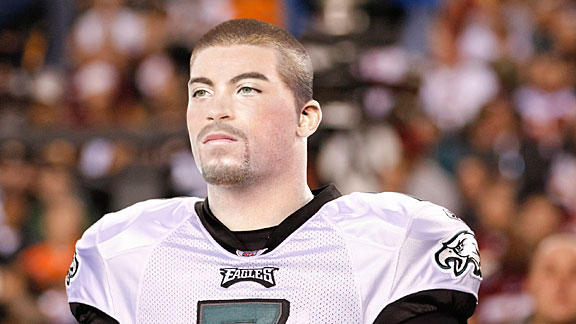
"White boys" like former Arkansas running back Peyton Hillis aren't supposed to play in the SEC
We all have things that interest us in life. For me, my most poignant memories will always center around football. Whether it involves going to college football games to tailgate with family and friends, playing the game, or watching my alma mater, nothing beats fall Saturday's.

Nothing.

Being relatively young, I was born years after the Southeastern Conference (SEC) teams finally integrated. At first, the quality and character of the Black student-athlete recruited was quite high, but this mindset evaporated quickly to the point where SEC schools now recruit Black athlete-students who barely qualify for admission to the schools (South Carolina head coach Steve Spurrier complained about admission requirements keeping out talented Black athletes) that are in the conference.

Sports Illustrated published an article in 1991 that bragged how Black people now dominated the SEC. Here are some excerpts from that story:
Even now he has vivid memories of games at Auburn, where the kindest chant was "Char-coal, char-coal," and of games at Mississippi, where Confederate flags were wielded with malice. Those were the most nightmarish trips for Vanderbilt's Perry Wallace, who in the winter of 1967-68 became the Southeastern Conference's first black varsity basketball player. He tried to block out the jeers, the taunts and the slurs, but sometimes it was impossible. Sometimes his palms would get so sweaty that a pass would slip through his hands, or he would get so jittery that he would have to go to the bench amid hoots of derision.
"Those were scary, scary situations," says Wallace, now an attorney in Washington, D.C., and a law professor at Baltimore University. "Every time we had a road trip, I approached it with the deepest sense of dread."

Today that all seems so long ago and so strange. Indeed, no league in the nation has benefited more from integration—check out all those postseason bowl and NCAA basketball invitations—than the SEC, which fought it the hardest. This season the conference's football teams are 57% black, its basketball teams 64%.
The SEC has been enriched by so many outstanding black athletes—names like Herschel Walker, Bo Jackson and Charles Barkley leap to mind—that it is difficult to remember that when Wallace made his debut for Vandy, the threat of violence was as real and near as the redneck hecklers sitting just behind the benches. David Sansing, a professor of history at Mississippi, remembers those times when he listens to the current debate on campus over the Alumni Association's request to Ole Miss fans not to wave Confederate flags at athletic events because doing so is an insult to blacks. "When you get down to it," says Sansing, "white Southerners and black Southerners still live in a world apart from each other, but it's better, and athletics has been a part of it. Take this flag thing. Twenty-five or 30 years ago, a white man could literally kill a black person in Mississippi without much fear of reprisal. Now we're talking about being insensitive to the feelings of blacks and scolding people for it. That's a hell of a difference."

The South was a racial battleground all through the 1960s, and its collegiate athletic teams, the most visible symbols of both the region's pride and its prejudice, were caught up in the emotions. Somehow, breaking the color barrier wasn't as difficult in the SEC's neighboring leagues, the Atlantic Coast and Southwest conferences, perhaps because Dr. Martin Luther King Jr. and the other civil rights leaders chose to fight in the heart of Dixie. The ACC was quietly integrated by Maryland, where the pioneers were football player Darryl Hill in 1963 and basketball player Billy Jones in '66. Nor was there much of a stir in the SWC when Texas Christian's James Cash became its first black basketball player in 1965 and Baylor's John Westbrook became the league's first black football player a year later.

Daniel Sorensen (#9) stated the "white boys" from BYU will show the SEC
What's funny is that now white people get jitters when they drive into Atlanta, Birmingham, Montgomery, Jackson (Mississippi), Memphis, Knoxville, Columbia, Tallahassee, the wrong parts of Tuscaloosa, New Orleans, Baton Rouge, and other Southern cities because Black people make them unsafe.

Sadly, it is the sons of these Black people that SEC (and ACC, Big East and other college football conferences) schools recruit with reckless abandon - many times going on probation for cheating during the recruiting process - though they have no desire to interact with these Black people outside of football Saturday's.

We have pointed that college baseball is more in line with the racial breakdown of SEC student enrollment, with white players comprising the bulk of the rosters. However, college football is the exact opposite. The University of Mississippi Rebels Brown Bears have thrown away all of their traditions (read this article by me at Alternative Right on the situation) in the vain pursuit of landing Black athlete-students to lead them back to the glory days of Rebel football -- when the team was all-white and actually won games.

The University of Mississippi has a student body population that is 82 percent white and 13 percent Black, but will see only four white players start on the football this season (out of 22 positions - 11 on offense and 11 on defense). The rest of the teams in the SEC are just as white - in terms of student body - but some are even worse when it comes to the football players. Here is Caste Football with a breakdown of the 2011 starters for the 12 SEC teams compared to the Mountain West Conference:

One way to see how Southern teams discriminate against White athletes more than any other conference in the country is to compare the darkest conference in the country, the SEC, with the Whitest conference in the country, the MWC. Even the high black populations in the states of the Old South don’t account for or excuse this extreme level of anti-white discrimination. Shown below are the number of White starters for each team.

SEC
Vanderbilt-9/22
Kentucky-8/22
Auburn-6/22
Alabama-5/22
Arkansas-5/22
LSU-4/22
Ole Miss-4/22
Tennessee-4/22
South Carolina-3/22
Georgia-2/22
Mississippi-2/22
Floirda-1/22

Total of 53/264 (20.08%) in the SEC

MWC
Boise State-16/22
Air Force-15/22
Wyoming-15/22
San Diego State-12/22
Colorado State-10/22
Texas Christian-10/22
New Mexico-7/22
UNLV-5/22

Total of 90/176 (51.14%) in the MWC
I pointed out in an article called The Opiate of America that the bulk of Black athlete-students enrolled at major colleges and universities would never have qualified and received special admission wavers were they not athletes. The reality of that statement is going to become increasingly clear this week during our college football preview.

I've thought a lot about this quote from 1955 that will be quoted below and I have finally realized I agree with it. Completely. This is from Time magazine:

Two thousand students from the Georgia Institute of Technology stormed through Atlanta one night last week, whooping up and down Peachtree Street, pushing aside troopers who tried to bar their way, and generally raising hell. At the State Capitol, the boys pulled fire hoses from their racks, adorned the sculpt head of Civil War Hero John Gordon with an ashcan. A dozen effigies of Governor Marvin Griffin were hanged and burned during the students' march, which culminated in a 2 a.m. riot in front of the governor's mansion.
Earlier in the day, the governor had incurred their wrath by a pinhead act: he asked the State Board of Regents to forbid the athletic teams of the university system of Georgia (e.g., Georgia Tech, the University of Georgia) from participating in games against any team with Negro players, or even playing in any stadium where unsegregated audiences breathed the same air. 

"The South stands at Armageddon," brayed Griffin to the regents. "The battle is joined. We cannot make the slightest concession to the enemy in this dark and lamentable hour of struggle. There is no more difference in compromising the integrity of race on the playing field than in doing so in the classrooms. One break in the dike and the relentless seas will rush in and destroy us."* 

The governor had a specific game in mind: Georgia Tech had contracted to play the University of Pittsburgh in New Orleans' Sugar Bowl on Jan. 2. Pitt has been selling its block of tickets on a desegregated basis, and Bobby Grier, a Pitt reserve fullback, is a Negro.
Judging by the current state of Atlanta, Memphis, Birmingham and hundreds of other southern cities and counties (not to mention American cities like Philadelphia, Baltimore, Detroit, St. Louis, Cincinnati,  Milwaukee, Cleveland, Buffalo, etc.), the dike burst everywhere in this once great nation.

All of these cities are awash in Black crime, with abandoned and devalued property (both residential and commercial), empty business districts, and lush in potential Black recruits to fill the rosters of SEC teams. White people do everything to avoid Black people, save when it comes to filling roster spots on their beloved alma maters football squad.

I've read more books and articles on the history of college football and the illustrious histories of the storied programs then I care to admit. This week, I will preview each of the SEC teams (basically, a racial history of the team, the school, etc.), plus I will discuss Notre Dame, Brigham Young University, Boise State, the University of Wyoming, the University of Washington, Georgia Tech, Ohio State University, and the University of Texas. 

It's going to be the most radical week ever at SBPDL. It might not be for every regular reader, but you learn more about why we live in Black-Run America (BRA) this week then all prior 130 weeks combined. 

Fitting, the University of Georgia and the University of Ole Miss both open up their 2011 schedules against teams sporting majority white starting lineups. Just like when an integrated Southern California came to play a lily-white Alabama (and out-manned Crimson Tide team) in 1970 and won convincingly - though BAMA would win the next year with only two Black players against that same USC team - in Birmingham, Boise State and Brigham Young University have the opportunity to show that white boys can win in the south in sports outside of baseball. 

BYU represents what all colleges and universities in America once looked like, sporting an Honor Code (that Black people hate) and sports programs that are majority white and reflect the majority of the students. Certainly, BYU represents what the SEC schools all looked as late as 1971. Just as BYU basketball star Jimmer Fredette was made fun of for being a white boy competing in the Black world of basketball, BYU football players have received scorn from Sports Illustrated and other outlets for playing white boys.

Daniel Sorensen, the starting strong safety for BYU, dared to point out that a bunch of white boys from Provo are getting ready to head to Oxford - he didn't state that the crowd will be 99 percent white - and play a team of largely unqualified Black athletes. Read The Blind Side by Michael Lewis or Meat Market to learn about the academic titans Ole Miss recruits. Here's what Sorenson said to the Daily Herald:
"The purpose of BYU, why we're here and why we're playing – and where we're trying to go with this program. It kind of fires you up. It kind of gets you excited.

"To go out there and play for a specific purpose of showing people that we're playing for more than football. This is a faith-based university and we're trying to represent that. The players, and the flag bearers.
"What if we go out there and dominate (at Ole Miss, Sept. 3) and people start seeing us? And they put us on the map, and we're on ESPN. And they start wondering who these kids are – what are they doing with their lives, and why are they so good?

"And maybe a bunch of white boys out there go down and beat up on an SEC team, a big, physical team like (Ole Miss). If we go in there and dominate, what does that say? It starts raising questions and curiosity.
"It starts making things interesting. Getting the pot stirred, and what not. Shoot, that's fun. That's what we're out here to do. We're out here to turn heads. We're out here to change the norm of BYU and what people think of us.

"I would like to see people start fearing us. I don't know. Kind of looking at BYU as a dominant team. Especially the defense. Nobody is going to want to run against us. Start setting that respect
"This is exciting. I can't wait to go down to Ole Miss."
"White boys." What a seditious statement! How dare someone notices that BYU is predominately white (one of the most monochromatic teams in all of college football as Sports Illustrated called them), especially a lily-white player like Sorensen! 

The SEC is perceived, by the entire country, as a Black conference, though Black males probably make up less than 2 percent of the enrollment of each of the 12 schools general student body population. They just don't have the grades to get in, unless the standards and qualifications for enrollment are lowered. 

Remember that current San Diego Chargers tail back and LSU legend Jacob Hester fought massive discrimination from predominately Black SEC defenses back in 2007:
Later in that same article, a telling statement was made by Hester, as he related a tale about Black people and their defense of the ownership of the tailback position:
"Still, there have been other instances in which Hester has removed his helmet without meaning to pull a fast one—like when he's trying to towel off the part of him that is most an anachronism: his white face.

"The fact is, in today's game, it's rare to see a white running back playing the role of dominant rusher on a college football team, let alone a national champion. And Hester
hears about it. In 2006, after shedding his headgear during a first-quarter timeout against Tennessee, Vols linebacker Jerod Mayo reacted as if he had seen a ghost. Said Mayo to Hester, "Shouldn't you be playing running back for Air Force?' "
The Air Force Academy fields one of the whitest teams in college football because few Black males have the academic qualifications, and high enough SAT/ACT scores to garner an appointment or scholarship there, or the dedication to stay the whole four years (if you leave the AF Academy after two years there, you owe the government your tuition back).
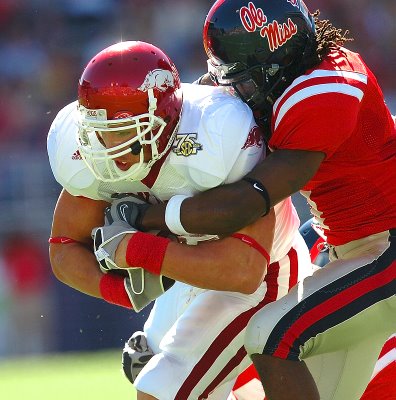
Peyton Hillis, a University of Arkansas graduate, faced (faces) the same type of discrimination from predominately Black NFL defenses. 

For daring to say "white boys" Sorenson has been blasted in the media. It's not like he called himself a "fucking soldier" like Black University of Miami tight end Kellen Winslow did in the early 2000s. 

Jason Franchuk, who wrote the piece with the quoted "white boys" statement, had this to say in a subsequent article:
Readers that wrote me directly apparently cringed at the quote and weren't thrilled with Sorensen's choice of words. They also admonished me to "be more careful" next time.
Here's part of my response to one reader:

However, I think Daniel's words were a lot more passionate -- and
not really offensive. He spoke from the heart about his excitement
for this season. What he believes the team can accomplish for
itself, and for the school. As for the "white guys" comment -- I
wasn't printing it to produce controversy. Let's face it, fair or
unfair, there are some absurd stereotypes in sports. Daniel, I
think, wants to break them down. Why is it that, even in BYU's best
recent years (or Air Force for that matter), "team speed" is never
one of their strengths? Why is it that Ole Miss absolutely has to
automatically have that advantage? I don't think Daniel believes
HIS team is "just a bunch of white guys." I think he, and
teammates, recognize that's the view point from the National
General Audience (at this point). Going to Ole Miss, SEC Country,
to start the season on ESPN -- I think he is giddy at the
possibilities of breaking that down. I thought the words were
earnest and passionate. Frankly, I'm surprised they're causing such
a uproar of racism. He's not a racist. Just a passionate,
happy-go-lucky kid who wants to show the world that he believes BYU
is really, really good on any level of distinction.
BYU is a predominately "white boy" team
Having more "team speed" is how people always describe the SEC, because it has more Black players. The perception being that whites are slower and not as athletic. Why is it that so few Black athlete-students graduate from college again? There was a day when white student-athletes from Auburn, Alabama, the University of Georgia, Ole Miss, Mississippi State, Florida, Tennessee, Vanderbilt, Louisiana State,  and Kentucky would go on to be doctors, lawyers, or prominent businessmen. A time when the legendary coaches like Shug Jordan, Vince Dooley and Bear Bryant were trying to not only win, but shape and mold future community leaders as well. 

Now, colleges recruit players that have a tendency to get into trouble. Most of those players are Black, as we learn from The Orlando Sentinel's Shannon J. Owen's (or Sports Illustrated's report on crime and college football):
Journalists and sports pundits alike have criticized, analyzed and hypothesized about why the system of college sports is breaking down at length in the past week. But we've been ignoring a big black elephant in the room. 
High profile football players caught in the center of booster controversies are disproportionately African American.
 USC's Reggie Bush, Oklahoma State's Dez Bryant, Georgia's A.J. Green, Alabama's Marcell Dareus, Auburn's Cam Newton and the latest poster child of "amorality" in sports, Terrelle Pryor of Ohio State, have all become infamous for proven — or sometimes unproven — cases of having friends with benefits.

We've seen public disgust directed at these athletes and now even NFL commissioner Roger Goodell is exposing his frustration with NCAA rule-breaking by punishing Pryor with a five-game suspension.

Oddly, Goodell didn't share this same outrage against Pete Carroll when he bolted out of USC's embattled football program to the Seattle Seahawks last year.

Black athletes who break the rules are more likely to face a harsher judgment in the court of public opinion or — even worse — Goodell's court. The facilitators of cheating, many of whom happen to be white, move on to NFL jobs or cushy TV jobs with significantly less criticism.

I have to wonder, does this discrepancy represent an underlying prejudiced attitude towards African-American athletes?

Contrary to popular belief, African-American men don't make up the majority of college athletes. According to the 2009-10 study from the Institute for Diversity and Ethics in Sports, black men made up just 24.9 percent of all college male athletes.

Equally interesting is the fact that black male athletes don't even comprise an overwhelming majority of Division I football players. Until last year, white athletes made up the majority of college football players since the 1999-2000 season. Black and white athletes currently share near equal representation at 45 percent, with African-Americans holding a slight edge at 45.8 to 45.1 percent.

I don't believe high profile black athletes are the only group of rule-breakers. I do believe they're more likely to get caught.

Given the string of high profile cases involving black football players, I spent hours conducting research, speaking with multiple sociologists, a former USC linebacker and even a college runner to determine if African-Americans really are breaking the rules more and if so why.

Ramogi Huma, president of the National College Players Association and a former linebacker at USC, summed up the questions best.

Cheating often takes place behind closed doors so it's impossible to determine who is doing what.
"You only know what comes out," he said.

It's not a stretch, however, to believe black athletes are targeted more by rogue agents, boosters and runners. Black athletes in skill positions like wide receivers, running backs and — in the modern era of college sports — quarterbacks are more lucrative and visible, which translates to greater opportunity for temptation.

Race aside, there is a long history of high-profile athletes receiving and asking for benefits. Most of them see this as an act of rebellion against a college system producing millions on their likeness and image.
But, as proven, this type of rule-breaking doesn't bode well for the image of black athletes.

"I think there does tend to be a perception that African-American athletes and African-Americans in general are more prone to criminal behavior and that might encourage certain individuals to approach them and perhaps not approach other athletes," said Timothy Davis, a law professor at Wake Forrest University who has authored several books about sports, business and race.
Characterizing an entire race of people based on the actions of some is prejudiced. And the reality is that we live in a prejudiced world.

I cringed when hearing that one of the United Kingdom's largest media providers, British Broadcasting Corporation, allowed guest analyst David Starkey to go unchallenged on his thought that "whites have become blacks" in reference to the disposition of rioters in London.

The inference here, of course, is that black people symbolize deliquency. Apparently, some of those rioters had been infected with "blackness."

As I see one high-profile athlete after another vilified for rule-breaking, I wonder if this same perspective about deliquency and blackness is being applied to college football.

I'm not condoning cheating, but I do hope the attitude towards corruption in college sports is not black and white.
It's not "white boys" getting into trouble (and if they do, normally a bunch of Black guys got them in trouble like at Auburn and LSU recently), but it is white boys keeping those graduation rates up. 

"White boys", Armageddon, and sports; it all comes down to college football being the tool that allowed Birmingham, Atlanta, Memphis, Columbia, and hundreds of other southern cities and counties to be completely turned over to the Black Undertow and corrupt Black city leaders and their Disingenuous White Liberal (DWL) enablers. 

When Boise State plays UGA this coming Saturday in Atlanta at the Georgia Dome and BYU kicks-off against the Mississippi Black Bears from Oxford, remember that Boise State and BYU reflect what SEC football teams should look like. 

As you'll learn this week at SBPDL: very few, VERY FEW of the Black athletes receiving free tuition to SEC schools have the grades or academic qualifications necessary for enrollment, especially at a school like UGA.



Friday, August 26, 2011

#68. All-White Sounding Hurricane Names

Why can't Hurricane Irene have a Black-sounding name?
"The Blacks" are an incredibly prideful people, possessing the highest self-esteem of any race on the planet despite professing a complete lack of any historical examples of actual achievement, innovation, or ingenuity to substantiate such racial self-worth.

Any and all achievements that "the Blacks" have to their credit in America is due to  pressure exerted by Disingenuous White Liberals (DWLs) to universally lowering standards in every industry (public or private) to ensure some level of Black representation and promotion.

Because the United States of America has been replaced with Black-Run America (BRA), eventually every demand by Black people to rectify past and present - real or fictional - injustices that they tragically had to endure will be recompensed.

It is only natural that one of the gravest examples of prejudice left in America will soon be remedied: the first hurricane to be named with a Black-sounding first name.

The bigotry and injustice of naming hurricanes with boring, lily-white sounding names must end; this form of oppression has kept Black people out of pursuing careers in any maritime industry and has convinced Black people that oceans and any body of water are inherently racist.

How dare hurricanes continue to be steeped in ethno-centrism and the cultural imperialism of white-sounding names when so many Black names are deserving of that honor. Perhaps because meteorology is an industry that has been historically ravaged by racism:

While not ubiquitous, a number of avenues exist for students seeking to pursue meteorology careers. Among the nation's Historically Black Colleges and Universities, Jackson State is the only one to offer a bachelor's degree program in meteorology. Williams said Jackson State's program graduates about 1 in 4 African-American meteorologists in the nation.

About 50 percent of Jackson State meteorologists graduates since 2002 have gone to graduate school, while about 25 percent go on to start careers in broadcasting as television and radio weather forecasters and another 20 percent go to work for government agencies, such as the National Weather Service, part of the National Oceanographic Atmospheric Administration.

Job opportunities in meteorology are expected to be better in private industry than in the federal government in the future, while opportunities in broadcasting are highly competitive, according to the Bureau of Labor Statistics in the U.S. Department of Labor.
 The National Oceanic and Atmospheric Administration has few Black employees worthy of commending, but never fails to promote them above all other lily-white staffers. One day, the injustice of ethnic chauvinism will end and a Black-sounding name (DeAndre, LaMarcus, Quindaras, LaToya, Demarcus, Phonecia, LaTisha, etc.) will be picked and official the hegemony of white-sounding names will end.

Until then, we can thank another member of Organized Blackness - Rep. Sheila Jackson Lee - for fighting the good fight:
Do devastating hurricanes need help from affirmative action? 

A member of Congress apparently thinks so, and is demanding the storms be given names that sound "black."
The congressional newspaper the Hill reported this week that Rep. Sheila Jackson Lee, D-Texas, feels that the current names are too "lily white," and is seeking to have better representation for names reflecting African-Americans and other ethnic groups. 


Rep. Sheila Jackson Lee, D-Texas
"All racial groups should be represented," Lee said, according to the Hill. She hoped federal weather officials "would try to be inclusive of African-American names."
A sampling of popular names that could be used include Keisha, Jamal and Deshawn, according to the paper.

Radio talk-show giant Rush Limbaugh says he was having dinner with his wife when he first learned of the proposal. 

"I just threw up my hands. I said, 'Has it come to this now?'" Limbaugh recounted on his show.
"There's discrimination and actually elected officials wandering around worried about the discrimination in the name of hurricanes. And hurricanes are destructive. You know nobody's very excited when a hurricane's heading their way, and yet here she is demanding that hurricanes be named after black people. 

"You know it used to be that hurricanes were named only after women because they were destructive and unpredictable. And that's the reason. The feminists grew upset about that, demanded that hurricanes be named after men, and so now, the civil rights leaders are demanding black names for hurricanes. 

Limbaugh continued his analysis, saying it was not the mainstream populace responsible for what he called the "Balkanization" of race relations in America. 

"It is these elected black leaders, the civil-rights coalitions – they're the ones that keep causing all this racial divide, they're the ones that keep calling attention to all this," said Limbaugh. "They're the ones that keep stirring this pot. They're the ones who don't want there to be any colorblind society. They're the ones who keep being agitated and trying to agitate others over all this, and now it's descended into the meaningless element of the names of hurricanes." 

According to the National Oceanic and Atmospheric Administration, hurricanes were for centuries named after the Catholic saints' days on which the storms fell. 

In 1953, the United States abandoned as confusing a two-year-old plan to name storms by a phonetic alphabet (Able, Baker, Charlie) when a new, international phonetic alphabet was introduced. That year, weather services began using female names for storms.
The crusade for a Black-sounding hurricane is not over, as we learned that Spanish and French names were added back in 2003, but Black-names were left out:

After Spanish and French names for hurricanes — such as Juan and Claudette — were added in 2003, U.S. Rep. Sheila Jackson Lee, D-Houston, said hurricane names should be more representative of the cultures they impact, including blacks:

Some black lawmakers don’t seem to mind, but Rep. Sheila Jackson Lee (D-Texas) does. “All racial groups should be represented,” said Lee.
The World Meteorological Organization began naming tropical storms after women in 1953. That made sense to scientists at the time who thought women and storms were both unpredictable. After feminist groups protested, men’s names were added in 1979.
The National Weather Service says hurricane names are derived from languages spoken in areas that border the Atlantic Ocean, where such storms occur. Yet that doesn’t explain why Gaston, Ernesto and Cindy were chosen and Antwon, Destiny and Latonya were passed over.
Lee said she hoped in the future the weather establishment “would try to be inclusive of African American names.”
Lee’s call for action may have been heard by the World Meteorological Organization, which selects hurricane names for the Atlantic basin. Because of their destruction, hurricane officials have retired the storm names Dennis, Katrina, Rita, Stan and Wilma. The replacements are: Don, Katia, Rina, Sean and Whitney.

Here are the top 20 sounding Black girl and Black boy names:

20 "Blackest" Girl Names

Imani
Ebony
Shanice
Aaliyah
Precious
Nia
Deja
Diamond
Asia
Aliyah
Jada
Tierra
Tiara
Kiara
Jazmine
Jasmin
Jazmin
Jasmine
Alexus
Raven

20 "Blackest" Boy Names

DeShawn
DeAndre
Marquis
Darnell
Terrell
Malik
Trevon
Tyrone
Willie
Dominique
Demetrius
Reginald
Jamal
Maurice
Jalen
Darius
Xavier
Terrance
Andre
Darryl
 The NOAA could pick from that list and have the perfect Black-sounding hurricane. What is the reason for this continued neglect and unprecedented level of racism? Perhaps the reason is something... sinister.

Consider the property damage down by your average hurricane or during a hurricane season. The loss of life, bad as it is, is never that substantial. Flooding, downed-trees, limited to major property damage for both residential and commercial buildings, and a lot of rain. Cities can recover from a hurricane, with communities coming together to help one another out in times of rebuilding and distress. People who fled the hurricane's path will return and, in time, tourism will come back and any business that shuttered will re-open.

However, cities cannot survive the Black Undertow. Atlanta, Birmingham, Memphis, Mobile, Montgomery, Birmingham, Baltimore, Newark, Detroit, Oakland, and any other city or county that goes from majority white to majority Black will never recover economically.

Worse, a hurricane brings one-time property damage; the Black Undertow participates in criminal activity that results in property damage all year around, driving down property value and forcing the closures of malls, big box chains, restaurants and other places of business that the fictional concept of Black-purchasing power can no longer maintain.

The rules governing the invisible hand of economics are immutable, and though a hurricane might momentarily interrupt a local economy via forced evacuation, water and property damage, cities can recover from the hardship faced from nature.

Local economies can not survive climate change or man-made climate change through the introduction and eventually usurpation of the city or county by the Black Undertow. The iron law of the invisible hand is immutable; bad money drives out good money.

The initial devastation of a hurricane might seem severe and insurmountable, impacting lives and uprooting businesses, but cities and towns can preserve and recover economically. A city or county overwhelmed by the Black Undertow will not recover, as the problems will aggregate over time until property has been devalued, homes abandoned, streets and  neighborhoods are no longer safe to walk down, and businesses are boarded up - not because of the impending arrival of a hurricane and inclement weather - because the     
white flight left a force with more long-term devastating abilities then a hurricane could imagine to do, in charge.

Hurricane Demarcus already hit Birmingham and Montgomery; Hurricane Latoya already slammed into Baltimore and Detroit; why should a Black-sounding hurricane slam into the Gulf Coast or Florida Keys?

Can't white-sounding names monopolize the destruction for once? Perhaps it's a good thing Black-sounding names are still in the back of the bus when it comes to hurricanes.

Stuff Black People Don't Like includes all-white sounding hurricane names, because Black people's narcissism knows no bounds. 


Thursday, August 25, 2011

ESPN Asks: "What if Michael Vick were White?"

Michael Vick. Black people's favorite athlete. Convicted dog killer. Still Black people's favorite athlete (according to an ESPN poll, not so much for white people). An ESPN poll conducted during Black History Month found that:

African-American sports fans who took part in the online survey also indicated the media had been biased in its treatment of black athletes. By a margin of 57 percent to 7 percent, the African-Americans surveyed say the media unfairly criticizes black athletes more than white athletes, while the white fans suggest there is no difference in the media's handling of various cases.

Of black sports fans surveyed, 65 percent say they admire Vick, compared with just 25 percent of the white fans.

ESPN asks: "What if Michael Vick was a Backstreet Boy?
He was supposed to be the Black quarterback who revolutionized the game (some think he still is that missing link to a completely Black-dominated league). Outside of one good season with Atlanta and a solid 2010 campaign, Vick has been a bust. One also has to ask: how many defenses taunted him as they did white running back Peyton Hillis in 2010 for being 'white'? How many defenses have bounties on Vick's head, as the Miami Hurricane's did on Tim Tebow's head back in 2009?

The National Football League (NFL) must do everything possible to not completely thug-out its product, as the National Basketball Association (NBA) did when they hedged all bets on Black 'thuggish' basketball and drove away fans, ratings, and corporate sponsorship.

That's why Peyton Hillis winning the vote from fans (over Michael Vick) to appear on the cover of the 2011 John Madden Football video game was such a relief to the NFL. Protecting the brand - a multi-billion dollar a year brand mind you - is more important to the NFL then turning your league into a veritable penal colony as the NBA did by allowing the thug mentality to take over.

Unfortunately, the league sings more and more players like Pacman Jones and Dez Bryant each year. 

Strangely, ESPN continues to push Black superiority in athletics (especially football) and published this strange article today that generated a lot of buzz all over the Internet. What if Michael Vick was White? written by Touré (he doesn't seem to have a surname), wonders how the incredibly Black Vick would be treated if he wasn't such a thug and instead was blessed with white privilege:
WHEN MICHAEL VICK PLAYS, I see streetball. I don't just mean that sort of football where you have to count to four-Mississippi before you can rush the quarterback, nearly everything breaks down and it's all great fun. I also mean street basketball. Vick's style reminds me of Allen Iverson -- the speed, the court sense, the sharp cuts, the dekes, the swag. In those breathtaking moments when the Eagles QB abandons the pocket and takes off, it feels as if he's thumbing his nose at the whole regimented, militaristic ethos of the game.

All of that is why, to me, Vick seems to have a deeply African-American approach to the game. I'm not saying that a black QB who stands in the pocket ain't playing black. I'm saying Vick's style is so badass, so artistic, so fluid, so flamboyant, so relentless -- so representative of black athletic style -- that if there were a stat for swagger points, Vick would be the No. 1 quarterback in the league by far. 

Race is an undeniable and complex element of Vick's story, both because of his style as well as the rarity of black QBs in the NFL. A decade after he became the first black QB to be drafted No. 1 overall, about one in five of the league's passers is African-American, compared with two-thirds of all players. But after his arrest for dogfighting, so many people asked: Would a white football player have gotten nearly two years in prison for what Vick did to dogs?

This question makes me cringe. It is so facile, naive, shortsighted and flawed that it is meaningless. Whiteness comes with great advantages, but it's not a get-out-of-every-crime-free card. Killing dogs is a heinous crime that disgusts and frightens many Americans. I'm certain white privilege would not be enough to rescue a white NFL star caught killing dogs. 

The problem with the "switch the subject's race to determine if it's racism" test runs much deeper than that. It fails to take into account that switching someone's race changes his entire existence. In making Vick white, you have him born to different parents. That alone sets his life trajectory in an entirely different direction. Thus when this hypothetical white Michael Vick ... wait, I can't even continue that sentence in good faith. I mean, who would this white Vick be? That person is unknowable. When you alter his race, it's like those Back to the Future movies where someone goes back in time, inadvertently changes one small thing about his parents' dating history and then the person starts to disappear. If Vick had been born to white parents, you wouldn't even be reading this right now. That Vick would have had radically different options in life compared with the Vick who grew up in the projects of Newport News, Va., where many young black men see sports as the only way out. 

This is not to say there aren't insights to be gained from hypotheticals. One pertinent question: Would a white kid have been introduced to dogfighting at a young age and have it become normalized to the extent that he builds it into his life after he joins the NFL? It's possible, but it's far less likely because what made Vick stand out among dogfighters is less race than class. The deep pockets of an NFL star led to a kennel that was too big not to fail eventually. But if it did, though, would this white kid have been busted? Remember, it wasn't suspicion of dogfighting that started the investigation that put Vick in jail. It was that element that we've all seen hold back or bring down so many athletes from the hood -- the entourage. Vick's cousin Davon Boddie was arrested and charged with possession of marijuana with intent to sell in Hampton, Va. When police asked him for his address, he led them to the home where Bad Newz Kennels was located. After that, Vick never had a chance.

Here's another question: If Vick grew up with the paternal support that white kids are more likely to have (72 percent percent of black children are born to unwed mothers compared with 29 percent of white children), would he have been involved in dogfighting? I ask this not to look for an excuse but to explore the roots of his behavior. Vick's stunningly stupid moral breakdown with respect to dogs is certainly related to the culture of the world he grew up in, which he says fully embraced dogfighting. But it's also related to the household he grew up in. 

Vick's father, Michael Boddie, was not a positive influence on him growing up. Boddie admitted to The Washington Post that he was a cocaine user and had been high and drunk around young Vick. He says he often prepared the family garage so Vick could have pit bull fights there. Boddie's account is disputed by a family friend, who says Vick's mother would not have allowed that. Either way, at some point in Vick's youth, his father became estranged from the family. This breakdown of Vick's paternal relationship is a pattern that's all too common among black men of his generation. Too many are left to define manhood on their own, so they gravitate toward the most charismatic and inspiring men in their world. Sometimes those men are gritty local sports coaches who teach them the value of hard work, but sometimes they're ghetto celebrities who are unsavory role models with bad habits. 

Ultimately, there is no separating Vick from his circumstances: his race, parents, economics and opportunities. Alter any of those elements and everything about him and how the world sees him would be unrecognizable.
So let's look at him a different way. Let's see him as someone in the third act of the epic movie that is his life, leading a team that many expect to see in the Super Bowl. Bob Marley's "Redemption Song" is playing underneath because the humbled protagonist has finally overcome his personal demons and has begun living up to his athletic promise. And to those who believe we should judge a man by how he responds when dealing with the worst life has to offer -- with how he climbs after he hits rock bottom -- Michael Vick has become heroic.

And that has nothing to do with race.

We don't believe in white privilege here, or at least not how Touré defines it. We do believe in Black Privilege and ask Touré this question: what would all of these Black athletes who get free rides to college (and rarely graduate) and then go on to play in the NFL - only to go completely broke upon retirement - do without sports? What positive job skills does a guy like Michael Vick, or the majority of the Black student-athletes studying "general studies" while playing college football or playing in the NFL offer the world outside of athletics?

SBPDL asks: "What if Michael Vick wasn't the embodiment of a nigger?"
What would their labor be worth on the free market if they didn't play football? It would be wise to quickly look at the top vocations - based upon percentage of Black people in that particular field - in America:

Why do Black people find employment so difficult to maintain when a position with the government (Federal, State or Local) is all but assured and guaranteed in BRA? The answer might be available in the US Department of Labor’s recent Labor Force Characteristics by Race and Ethnicity 2009 report:
In general, the labor market problems experienced by Blacks and Hispanics are associated with many factors, not all of which are measurable. Some of these factors include a tendency to be employed in occupations with high levels of unemployment, lower average levels of schooling, greater concentration in the central cities of urban areas where job opportunities may be relatively limited, and the likelihood of discrimination in the workplace. These factors and others may help explain the acute labor market difficulties Blacks and Hispanics encounter, especially during economic downturns.
From this report, we learn the top 10 occupations in America with the largest percentage of Black employment (for those wondering, the lowest is here):
1. Barbers—35.0%
2. Nursing, psychiatric, and home health aides—34.0%
3. Residential advisors—29.6%
4. Security guards and gaming surveillance officers—28.6%
5. Postal service clerks-28.3%
6. Baggage porters, bellhops, and concierges—27.1%
7. Postal service mail sorters, processors, and processing machine operators—26.4%
8. Taxi drivers and chauffeurs—25.7%
9. Bus drivers—24.9%
10. Parking lot attendants—24.4%
We've said it before and we'll say it again: without sports, positive examples of Black people in America would not exist. Even with sports, the most heroic Black athletes have the moral character of a guy like Michael Vick.

Michael Vick is a byproduct of Black culture in America. His brother, Marcus Vick, wasn't as lucky as him. Were Vick a white guy, he'd be a byproduct of white culture. A guy like Matt Jones, the former quarterback at Arkansas, was a much taller (and whiter) version of Vick, but he got moved to receiver after being drafted by Jacksonville. After testing positive for cocaine, Jones was gone from the league.

Vick killed a bunch of dogs and was welcomed with open arms by the incredibly Black town of Philadelphia, where Black Flash Mobs Mahogany Mobs terrorize white people and threaten to shutter businesses because of their disruptive and criminal nature.

Were Vick a white guy, like say one of the biggest knuckleheads in NFL history Ryan Leaf, he probably wouldn't be bankrupt. But like JaMarcus Russell and Vince Young (all three Black QBs signed huge contracts), he is bankrupt.

Michael Vick is given a pass due to his Blackness, because one can never criticize Black people or their (lack of ) character.

In a hilarious 2011 cover-story on the NFL Lockout in USA Today, a story on the plight of undrafted free agents profiled the incredible Black Darren Evans of Virginia Tech and this sob story of waiting for the lockout to end so he could pursue his dream of professional football:
Married and a father, with another child on the way, former Virginia Tech running back Darren Evans suddenly found himself in the unenviable role of unemployed football player in a shuttered league eight weeks ago.

With one season of eligibility remaining, Evans, 22, gambled and declared for the NFL draft in April after advisers told him he was a lock as a middle-round pick. As the three-day draft approached an end, Evans says, the Washington Redskins called to say it was unlikely any team would select him.
"After hearing those words … everything kind of went blank," he says bleakly.

Without a new labor deal, rookie free agents remain in free fall.
In Evans' case, financial pressures bear down on the 230-pounder like a menacing middle linebacker. He and his wife, Taneesha, live with one of his cousins in their hometown of Indianapolis. The couple get by on savings and the largesse of family members.

"If this whole (football) thing just totally blows up in my face, I will go to work," says Evans, who as a redshirt freshman in 2008 rumbled for a then-school record 253 yards rushing against Maryland.

"If I get knocked down, I have to get up, because I will have three people depending on me."
Evans' economic concerns are one example of the anxiety affecting his unsigned brethren.
The best of them would have received signing bonuses ranging from $10,000 to $25,000. Under the expired labor agreement, the minimum NFL salary — which is typically what such players are paid — was $325,000 for rookies.
If Michael Vick were white, one wonders if he'd be in the predicament of Darren Evans. One should remember that Adrian Peterson claimed he was a 'slave', though he made $10 million last season for the Minnesota Vikings. It's hard to conjure a profession where Peterson's labor would be valued at $10 million a year, but luckily Black-Run America (BRA) gives us sports where such miracles exist. 

Vick would probably be working at a McDonald's and living off of EBT/Food Stamps if he didn't possess the ability to play football at the professional level. Were he a white guy, he might have utilized his scholarship to Virginia Tech to garner a degree in a useful field that would enable him to have a career once his playing day were over. In that same article from USA Today, we learn about a white player who was also an undrafted free agent:
Former Texas Tech quarterback Taylor Potts, a pre-med graduate, spends his days working out in Lubbock — when he is not shadowing an orthopedic surgeon. He also plans to get married next month.
"We (players) are pretty much at the mercy of the lockout," Potts says. "I have a lot of time to beef up a Plan B. Plan A is to still play football — although Plan B is becoming a bit more realistic."
If Michael Vick were white, he'd have made a contigency plan to do something besides playing football. Taylor Potts did. Is 'white privilege' merely the ability to plan ahead and have other options available for potential employment? If that is the case, Darren Evans is screwed. 

That Michael Vick is a hero to Black people tells me all you need to know about Black people and their monolithic character standards; "as long as you are Black, you are absolved in our minds from any criminality."
Look, plenty of white kids grow up in poverty (or whatever the concept of "poverty" means in America), yet jails are disproportionately filled with Black people. Why is that? 

Without athletics, positive images of Black people are non-existent in America. Even with athletics, the best images we get are of people with the character of the likes of Michael Vick.

Black people don't like Michael Vick haters because he is a legitimate hero in their eyes. Were he white (and had he committed the same crimes of Vick) he'd be completely shunned by white people. 

That should tell you everything about the difference between white and Black people.

The better question that no one wants to ask about Black athletes like Michael Vick is simply this: "What if Michael Vick didn't act like a nigger and what if a fawning, sycophantic predominately white sports media and every member of the Black community stopped making excuses for his thuggery?"
Note: The SBPDL Guide to College Football is going to be something incredibly radical. It starts tomorrow. We will still be posting random stories as they come along and # posts. There's just so many great stories about race and college football that need to be told. We start tomorrow.


"It's Free, Swipe Your EBT!"

Looking at Newsone.com, I came across this hilarious story about a rap 'song' that extols the virtues of swiping your EBT:
A new video called “It’s Free Swipe Yo EBT” video is angering many African Americans across the web.
The video, first spotted on Power107.5.com, showcases a woman rapping about how proud she is of being on government assistance, while cursing up a storm.
Actually, EBT Cards cost taxpayers billions
As of 2006, 39 percent of Black people were on food stamps. Unfortunately, 2011 numbers are unavailable but John Derbyshire notes:

As soon as you start to look at the numbers, though, you come up against the race issue. Here are the 2007-08 TANF tables—that’s Temporary Assistance for Needy Families, a federal program—broken up by state and race. So for example, in the state of Maryland, which is 30 percent black, 80 percent of TANF-receiving families are black.

It’s the same with food stamps, which nowadays come under SNAP—that’s the Supplemental Nutrition Assistance Program. The New York Times published a neat interactive graphic on SNAP usage a couple of years ago. The accompanying article tells us:
Nearly 12 percent of Americans receive aid—28 percent of blacks, 15 percent of Latinos and 8 percent of whites….Half of Americans receive food stamps, at least briefly, by the time they turn 20. Among black children, the figure was 90 percent.
Knowing that more than 50 percent of births in America are to non-whites now (first time ever), it is important that we understand the non-whites having these children are dependent on the state (i.e. taxpayers) for fitting the bill for feeding their progeny:
In fact, a shocking 49 percent of all babies born in the U.S. are born to families receiving food supplements from the WIC program, according to Jean Daniel, spokesperson for the USDA.

This video is Black-Run America (BRA) perfectly encapsulated by the fitting moniker, "It's free, swipe your EBT!" In many major cities, upwards to 50 percent or more of Black people are on EBT cards. This doesn't include the free lunches (and sometimes breakfast) that predominately Black school districts receive. Detroit will now offer all students free lunches so as to eliminate the stigma that receiving a free lunch might present to Black kids whose parents - more than likely - also live off TANF/Welfare, EBT cards, and Section 8 Housing:
All Detroit Public Schools students will receive free breakfast, lunch and snacks in an effort to remove the stigma of being from a low-income family.

The U.S. Department of Agriculture program chose Michigan as one of three states to participate in the pilot program. Charter schools and districts in Michigan can participate if at least 40% of students are eligible for public assistance. 

“One of the primary goals of this program is to eliminate the stigma that students feel when they get a free lunch, as opposed to paying cash,” said DPS Chief Operating Officer Mark Schrupp. “Some students would skip important meals to avoid being identified as low-income. Now, all students will walk through a lunch line and not have to pay. Low-income students will not be easily identifiable and will be less likely to skip meals.”

I've read on a number of Black entertainment Web sites where they express horror at the song "Swipe Your EBT," but I highly doubt such criticism of their fellow Black people is anything to get excited about, considering that 90 percent of Black people will be on EBT/Food Stamps at some point in their lives.

We move inexorably closer to the Day the EBT Cards Run Out. The angry Black mothers in Clayton County, Georiga (whose EBT cards were good for nothing upon being swiped) show that the mentality of "It's Free, Swipe Your EBT" is easily replaced with "My kid's ain't eat since this morning!"

Every problem in America comes down to race; it always has and it always will.

If the "It's Free, Swipe Your EBT" song angers and infuriates the Black community, then tell your fellow Black people (who rely on EBT/Foodstamps) to get off of them. Then, tell them to get off of TANF/Welfare, stop breaking the law, and refrain from participating in Mahogany Mobs.

Personally, I think "It's Free, Swipe Your EBT" is a catchy tune, and one can only hope it catches on like Rebecca Black's "Friday" song did. This video is perfect representation of the Black mentality. Juxtaposed with the video on what happens when the "EBT card no longer swipes free" in Clayton County, it's obvious we are moving closer and closer to a pivotal moment in world history.


The Day the EBT Card runs out is coming to a city near you. Black people won't have much to rap about then.

Never forget that we could have been on Mars, but we had to pay for Black-Run America.


Clayton County Food Stamp Snafu Angers Many: MyFoxATLANTA.com