This website will serve to educate the general public on Black people and the Stuff That Black People Don't Like. Black people have many interesting eccentricities, which include disliking a litany of everyday events, places, household objects and other aspects of their everyday life.
Black people are an interesting subject matter and this website will chronicle the many problems in life that agitate this group of people.
To suggest material, please contact sbpdl1@gmail.com
Religion and abortion are two topics that we don’t like to discuss here. But one topic we quickly will discuss is the recent decision by the United States government to grant asylum to 28 homosexual Jamaicans. Do we even need to explicate what this means? The article simply states:
In an unprecedented victory, 28 homosexual Jamaicans, who were persecuted due to their sexual orientation, have gained political asylum in the United States. The success of their claims reflects the degree of persecution suffered by gays in Jamaica.
Since 2007, Great Britain, the former colonial power that introduced the island's sodomy laws, has granted asylum to at least five Jamaicans on the grounds that their lives were in danger due to their sexual orientation.
The individuals were assisted by Immigration Equality, a network of pro bono attorneys which strives to secure asylum for lesbians, gays, bisexuals and transgenders.
"By offering them a safe haven, the United States is not only saving their lives, but benefiting from the talent, skills and service these asylees bring to our country," a spokesperson from Immigration Equality said. "We are proud and honored to help them begin life anew here in their adopted homeland."
The organization is reported to have 97 additional cases filed in 2010 and several filed previously that are awaiting review.
Renowned largely for its music, culture and reputation as one of the most favored Caribbean travel destinations, Jamaica is also infamous for its intolerance and unbridled violence against homosexuals. Homosexuality, known throughout the Caribbean as "buggering," remains a criminal offense in Jamaica and is punishable by up to 10 years in jail.
How many people across the globe live in nations where homosexuality is outlawed, sodomy a crime? How many people will read this story and decide that applying for asylum to the United States is an opportunity at a better life?
The only problem is that these people are white, productive and have the odious stench of racism upon them. It is this repellent disease that seals their fate of international (malignant) neglect:
Since 1991, there have been 11,785 attacks and 1,804 murders, and the problem is getting worse, Andre Botha, the president of Agri SA warned.
Mr Botha told the South African parliament's police committee: "We're talking about two attacks per day, we're talking about two farm murders per week, and it's increasing. What is a very worrying aspect is the brutality in which the murders are conducted."
It follows the recent killing of the far-Right leader Eugene Terreblanche, who was allegedly murdered by two farmworkers.
His death inflamed South Africa's race tensions amid anger over a "shoot the Boer [farmer]" slogan sung by Julius Malema, the ANC Youth League leader.
Only Georgia – the country – sees the value in allowing these beleaguered white South Africans to emigrate from that wonderfully diverse land run by Black people and showcase their farming prowess within their borders. It is Georgia that will benefit from the Boers talent, skills and service these asylees will bring to their country.
A nation that welcomes people from a land - because of their sexual orientation and the persecution they incur in Jamaica - that has produced absolutely nothing beneficial to society, yet denies asylum or publicizing the plight of a people who built a nation from a vast wilderness of nothing has shown its true colors.
White South Africans are about as feckless – in the eyes of those in power in BRA – as the victims of Omar Thornton’s rage. For being a “racist” or for merely “being white” in the first place, they have been designated for the ash heap of history. The sins of the father…
Don’t think for a second that this philosophy doesn’t translate to American whites and, in due course, Europeans and Australians.
All members of any victim group, be it Black, gay, transgendered or mentally retarded (preferably a combination of all four) are worthy asylum seekers in the eyes of the United States government.
That racist trash festering in Mandela’s glorious rainbow South Africa, screaming about some unknown plight called “reverse-racism” or “reverse-discrimination” deserve the fate that awaits them. Any white person who dares bemoan their plight hasn’t attended a lecture on white privilege.
Why do stories like these two remind us at SBPDL of the lesson learned from the much maligned movie The Village? When you understand what BRA represents, there is no turning away or running into the woods to escape and hide.
You can't address any of the problems in America - whether increasing or decreasing taxation, improving education (its working pretty good for whites and Asians), stopping manufacturing companies and white collars jobs from being outsourced, improvements in transportation and cutting the size of government - without addressing that white elephant in the room, Black people.
Government payrolls are filled with otherwise unemployable Black people, an entire middle-class created because private companies can only hire so many diversity enforcers. Take a look at Prince Georges County to see the ability of these Black people once they are left to their own devices.
The Equal Employment Opportunity Commission (EEOC) makes it virtually impossible for a company to operate, without fear of being questioned for under-employing obviously under-qualified Black people. Companies that could employ Americans then move overseas to China, India or other nations where millions, sometimes billions of higher qualified people work completely devoid of the fear of violating someones civil rights.
Does Stuff Black People Don't Like believe in the American Dream? No, we believe in the Pre-Obama American Dream. We believe in a restoration of The Manifest Destiny.
We reject liberalism completely. We reject the belief in equality completely. Those who question the concept of equality are always called "close-minded" or "ignorant." Imagine if you were an alien new to earth, seeing the world for the first time. Would you honestly surmise that the gross differences in standard-of-living between the United States, Western Europe, China and Japan versus the continent of Africa and Haiti (and any area within the United States with a majority Black population) was due to anything but inequality?
The amount of lying it takes to create a worldview where someone can convince themselves that equality is factual is tantamount to an undying devotion to the belief that the earth is flat.
The POTUS 2011 State of the Union was delivered to people who have a steadfast devotion to the perpetuation of the belief in the equality. It's time to stop lying to ourselves. The world isn't flat.
No amount of money will ever bridge the racial gap in learning. Companies will continue fleeing in America, because of laws that make the firing of Black people once hired virtually impossible to fire.
It's time to mention the unmentionable. Race is real. Very real.
Is it wrong to call the World Cup in South Africa - an event hasn't even started yet - a failure? No.
It is not. We are told by Time magazine's Managing Editor Richard Stengel that Nelson Mandela is the most important person and greatest human on the planet (in that magazine's World Cup preview issue). Stengel wrote a book called Mandela's Way: Fifteen Lessons on Life, Love, and Courage, which serves as primer for the uninitiated in learning of the greatness of Nelson Mandela, a God among insects.
No man on the planet - according to Stengel - is as benevolent, magnanimous, genteel, gracious, refined and worldly as Mandela. He is not just a treasure to the multiracial nation he gave birth to, but a treasure to the world.
Well Mr. Stengel, the most important and greatest representative of human decency is also the man who presided over the complete ruination of an entire nation and is directly responsible for the hundreds of thousands of lives (both Black and white) lost in South Africa since that nation had the glories of "Democracy" forced upon it by Disingenuous White Liberals from around the world.
The phone rings endlessly in Kyle Condon's office. As the World Cup nears, tourists and foreign businessmen spooked by South Africa's crime rate are calling him to hire bodyguards.
"We have brought in 45 contractors who are being assigned to different projects, but we might have to recruit more," said Condon, who runs D&K Management Consultants.
"We have increased our revenues and our turnover by about three-fold" thanks to the World Cup, he said.
His clients are spending R2 000 to R4 000 a day, depending on their level of risk, to be accompanied by a man or a woman carrying a nine-millimetre firearm.
Many of the bodyguards are former soldiers or police officers. They're trained in marksmanship, emergency driving, first-aid, and fastidious planning.
"It's not about jumping in front of bullets. That's for movies with Kevin Costner," Condon said. "What we do: we plan your life for you during your stay. We are a kind of personal assistant."
His clients, all well-heeled but from varying backgrounds, know that South Africa has one of the world's highest crime rates, with an average of 50 killings a day.
They call Condon for "peace of mind and convenience", he said.
Fear of crime isn't limited to foreigners. Private security services are a mushrooming business in South Africa, posting 13% annual growth since the end of apartheid in 1994.
The 6 400 security firms accredited by the government have a collective turnover of R14-billion ($1,9-billion). That jumps to R40-billion when makers of electric fences, video surveillance and other services are included.
"Crime in South Africa generally increased from 1994 to 2003-2004," said Gareth Newham, a researcher with the Institute for Security Studies.
Crimes that cause fear "Since then crime has dropped by 24% globally, but certain categories of crime have increased like house robberies, business robberies and car hijacking, and those crimes cause a lot of fear."
Security companies "use an existing fear to sell their products".
"People are scared. If they can afford it, they will," he said.
As a result, many upmarket neighbourhoods resemble bunkers.
Houses are surrounded by tall walls topped with electric fences.
Some streets have checkpoints and many are patrolled by private security firms.
South Africa has 375 000 private security guards, and 180 000 police officers.
Behind the walls, gardens have motion detectors linked to alarm systems and illuminated by spotlights. Windows have metal bars, and doors have multiple locks.
Inside, "panic buttons" let owners alert the security firm to a break-in, while metal gates lock off bedrooms from the rest of the house. Big dogs and hidden safes are also common.
Poorer neighbourhoods use barbed wire, broken bottles and nets on windows to keep intruders out.
"Everyone wants to protect themselves. People have guns, knives, batons," said Junior Yele, an official at Boa security services, which has won about 20 bodyguard contracts.
But he says there's a much cheaper solution to avoid criminals.
"The main advice in South Africa is don't show that you have money, don't attract attention."
Yes. To ensure the safety of World Cup fans, billions have been spent in the nation that owes its happy existence to the greatest man on the planet, Nelson Mandela.
The police presence will be immense in South Africa. The mere admission of this fact illustrates the complete failure of South Africa and Democracy under Mandela (and after him), and with the World Cup mired in such great fears of wanton criminality suppressed with an unprecedented level of international police force helps us understand the mighty contributions of the world's most important citizen:
JOHANNESBURG – The array of statistics South African officials have been touting in the lead up to the start of the World Cup on June 11 has certainly been impressive.
Fifty-five thousand new police officers, $88 million in new police equipment, the largest deployment of Interpol officers in the organization's history and up to eight police officers from each of the 31 visiting teams in country to assist in crime prevention.
Yet, despite the heavy investment in South Africa's defense infrastructure, this cup-crazed country has found itself facing fresh criticism over its security preparations on the eve of the big event.
South Africans were hit with a bombshell when a Johannesburg paper article reported that members of the U.S. Congress had been briefed on credible threats of attacks being planned by terrorist groups like al-Qaida and the Somalia based, al-Shahaab.
The report said that operatives from militant organizations had trained in terror camps in northern Mozambique may have already infiltrated South Africa and were poised to strike World Cup matches and events.
South Africa's top security officials were quick to dismiss the claims of a terrorist threat and expressed confidence in the revamped security force being rolled out.
Domestic crime Whether the new revelations are enough to sway travelers to abandon their World Cup plans remains to be seen. But it is just another blemish on South Africa's desperate bid to change the perception of the country as a rough and tumble place unsafe for such a massive global event.
Recent statistics demonstrate that public perception is not far from the truth.
Statistics released by the South African Police Service showed that between April 2008 and March 2009, this country of 48 million million people had 18,148 murders and 70,514 sexual crimes. By comparison, the United States, with a population of 300 million, had 14,180 murders and 89,000 sexual crimes in 2008.
That means almost 50 murders are committed each day in South Africa. Yet, in the most recent State of the Union address by President Jacob Zuma in February, crime was only mentioned three times in his speech and no concrete prevention strategy was mentioned, much to the frustration of many South Africans.
The widespread perception of how commonplace violent crime is here may be far more damaging to the 2010 World Cup then any terrorist threat. People who live here are so used to the ubiquitous crime that they speak of it as something that can’t be avoided, only confronted.
At a popular watering hole in Johannesburg's suburb of Melville over the weekend, long-time patrons watched highlights of last week's South Africa vs. Columbia friendly match and offered player profiles over the dull groan of thousands of horns from the TV.
When discussion shifted inevitably to the front page news of the day about terrorist threats, opinions divided sharply over the veracity of those reports. However, all were quick to drive discussion away from terrorist threats to everyday crime. Perhaps unsurprisingly, the 55,000 additional police quickly became the butt of many complaints.
"Fifty-five thousand new police and I still get nervous if I have to walk home alone late at night" moaned one area resident working on a World Cup project. Another long time resident wondered aloud “Fifty-five thousand, but where are they?”
Indeed, driving extensively through the famously poor area of Soweto and Soccer City – the site of one of the beautiful new stadiums South Africa has erected for the World Cup – it is difficult to sense any significant police presence, a sentiment confirmed by longtime residents of Johannesburg.
Yet, despite the pervasiveness of crime here and the looming threat of terrorist threat, it seemed that night nobody at the bar was deterred from their belief that this World Cup was going to be the biggest, most successful party in African history.
Here’s to that dream coming true.
Stengel's subject of immense, intense and insufferably hagiographical words written in praise of Mr. Mandela seem astonishing to anyone presented with the enormity of the situation South Africa is faced with currently.
Only in the world of the Disingenuous White Liberal could a nation beset with unparalleled criminality have its progenitor be honored with the title of "world's greatest living person."
And that is what Time called Mandela - "the greatest man on earth".
A nation where hundreds of thousands - if not millions - have cried out in vain while their humanity and life is extirpated in the blink of an eye through unchecked criminality have one man to blame - Nelson Mandela.
The legacy of South Africa is his alone. The billions spent on security for the 2010 World Cup shines a bright light on the failure of Black rule, Democracy and the greatest man on earth, Nelson Mandela.
Regardless of what happens in South Africa starting June 11th, the 2010 World Cup has been a monumental failure. Every private citizen visiting that nation accompanied by a private security force is testament to this fact, as is the billions spent on enhancing the police-state infrastructure to give off the impression of momentary stability in Mandela's South Africa:
The national government spent 34 billion rand on preparations, while the 10 provincial administrations and nine host cities contributed more than 9 billion rand.
About 44,000 police officers have been assigned to protect teams and fans during the competition. More than 5,700 incidents of serious crime are reported in South Africa each day, including 50 homicides, one of the highest rates in the world.
Of course, the shockingly high amount of money FIFA took out in insurance to protect the investment of the World Cup in South Africa is but another melancholy reminder of why this event is already a failure:
The Fédération Internationale de Football Assn. is protecting its investment with $650 million in coverage to protect against postponement or relocation of the event, which runs June 11 through July 11. The bulk of the coverage, which will remain in place for the 2014 World Cup in Brazil, is reinsured by Swiss Reinsurance Co. and Munich Reinsurance Co.
FIFA did not purchase insurance to cover cancellation of the World Cup. The organization chose not to cover that risk because “even if the event is delayed for any reason, it is extremely unlikely that it would be called off,” a spokesman said in an e-mail.
Insurance and security in South Africa will be in place for 64 matches played in nine cities during the monthlong World Cup centered in Johannesburg. Estimates of the number of visitors have ranged as high as 450,000 to watch the games.
Stuff Black People Don't Like declares the 2010 World Cup in South Africa a disaster before the first official contest of "the beautiful game" is played. There is still time to move the event.
Do it. Or risk the complete detonation of Black Run America in the process of South Africa's televised debacle.
For the ranks of those who can see grow by the day. Why broadcast the state of a formerly white run country (and white founded) besieged by a visibly Black majority that comprise the leadership of its current government?
People in America know why Detroit is in ruins. Now, the entire world will be witness to what South Africa has become. The common denominator of both of those places? Populated by 90 percent or more Black people.
There is still time to move the games, for remember the ESPN tag line of the 2010 World Cup: One game changes everything.
One game will showcase Mandela's true legacy in ways no amount of fawning prose - basically written Felatio - courtesy of Time's Richard Stengel could counteract.
While South Africa's murder rate has declined since 2004, it is eight times higher than that of the USA. In Gauteng, a province that's home to 10.5 million people and the World Cup host cities Johannesburg and Pretoria, there were 1,940 violent crimes reported for every 100,000 people in 2008. The violent crime rate in Michigan, which has a similar population, was nearly one-fourth that number.
BaySecur, the security consultancy in charge of Germany 2006, said: "The possibility for the players of moving outside of the hotel boundaries should be kept to a minimum.
"Otherwise there must be a full escort; armed security guards and bullet-proof vests for the players."
The South African government has announced a dedicated force of 41,000 police officers, following a huge recruitment drive to increase the numbers of officers by 55,000 to over 190,000 by the end of 2009.
Yes, the 2010 World Cup in South Africa is already a failure.
The idea behind this marketing strategy is to imply that with the first game being played in South Africa (on June 11) all is changed, changed utterly.
The continent of Africa has never hosted a World Cup and curiously, the only nation capable of fielding this global event is South Africa. But 16 years removed from international boycotts levied by the entire world, South Africa was graciously allowed to formalize normal trading relations once minority-rule by those who created that nation was supplanted with majority-rule by those who had the good fortune of living on that continent in vastly superior numbers.
Now, we are about to find out how wonderful life in South Africa is now, thanks to the benevolent rule of Africans over that of the malicious reign of terror imposed by the white minority called Apartheid. We’ve discussed South Africa before at SBPDL, but next week you’ll be treated to the most in-depth preview of the coming World Cup in South Africa available anywhere.
The couple is thoroughly conversant in South Africa's challenges: crime, poor schools, a recent outbreak of anti-immigrant violence, political corruption. They recount headlines about black students outside of Cape Town who went on strike because their class size of 60-plus prevented anyone from learning anything. "It can be discouraging at times," says Eberhard.
They also know that somewhere between 500,000 and 1 million white South Africans, depending on whose statistics you believe, now live in Britain. Some have gone seeking opportunity; others have fled what Young calls "the more difficult aspects of being a young democracy." Crime is high on that list. The U.S. State Dept. still ranks South Africa as among the most crime-ridden nations on the African continent, reporting that it has "the highest incidence of reported rape in the world."
The individual behind this site has read every book possible on the so-called “Beautiful Game” that Americans call soccer and the world calls futbol. Trying to understand a sport so many Americans – and Black people in particular – shy away would difficult, were it not for the bountiful supply of books that have been published recently that explain the game to a laymen and adds further proof to the thesis of this site: without sports, Black people would have absolutely no positive role models.
One Game Changes Everything. If the World Cup in South Africa goes off without a hitch, despite the fact that The Wall Street Journal has already published reports on the melancholy ticket sales and interest in traveling to the ‘Rainbow Nation”, then what is gained?
Will the Disingenuous White Liberal's of the world smile if the World Cup goes off without any problems, since it was FIFA President Joseph “Sepp” Blatter who pushed for the tournament to be hosted on the Dark Continent:
But the FIFA chief said his first task was to deliver a successful World Cup in South Africa in June and July. "The World Cup in South Africa is my World Cup," Blatter said.
"I wanted the World Cup to go to Africa and I have to see it through. The international media, especially in Europe, are watching me.''
Blatter told The USA Today that his great hope for the games is that Nelson Mandela can be present for them, since the current state of South Africa is his legacy:
But, as FIFA president SeppBlatter has suggested all along, South Africa 2010 could have a lasting effect throughout Africa, not just in the host country.
"We can all applaud Africa," Blatter said way back in 2004, when this cup was awarded. "The victor is football. The victor is Africa."
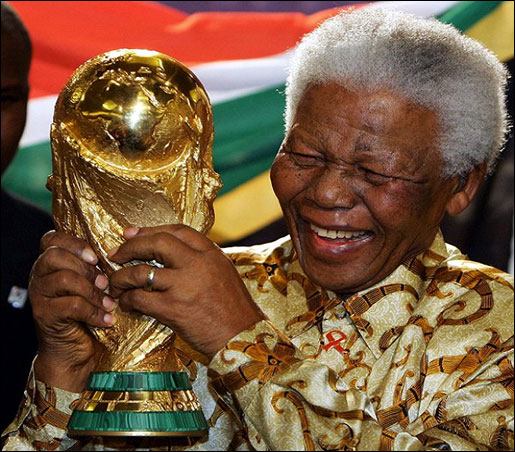
Blatter remains hopeful Nelson Mandela will be healthy enough to attend the opening game at Soccer City, one of 10 stadiums being used in nine cities. South Africa's most famous citizen campaigned hard to bring the World Cup to his country, and tears of joy filled his eyes when it won the tournament.
But Mandela is 91, and rarely makes public appearances anymore.
"We cross fingers that Nelson Mandela ... can realize this dream. And his dream would be to be at the opening of the World Cup," Blatter said. "It will be his World Cup."
Already, reports of strikes within the transport and electrical industries threaten the peace and harmony of the World Cup. And we are still two weeks away from the first kick. Security for the games has been a huge concern, as South Africa had 19,000 murders in 2008 (50 per day). The Telegraph in England published a story on May 28 in an attempt to downplay the violence in South Africa:
Much has been said in the build-up to the World Cup about South Africa's crime problem and the threats to visiting supporters. While crime is a serious problem here, it needs to be put in perspective. The country's murder rate has decreased from 67.9 per 100,000 in 1995 to 37.3 in 2009. That is an overall decrease of about 44 per cent. Of course, this figure is still extremely high when compared to the global homicide rate of 7.6 per 100,000 and, in real terms, amounts to almost 50 murders per day. However, in almost 80 per cent of murders, the victim and killer are known to each other – in other words, it is within a social context that poses no direct threat to strangers. The same can be said for other so-called "social fabric" crimes such as rape, assault and attempted murder.
House robbery, business robbery and car hijackings are currently South Africa's biggest crime threat, and attempts to address this problem have not been very successful. However, with the possible exception of car hijackings, they, too, pose little threat to tourists. Visitors who rent cars may face the same risks as South Africans as far as hijackings are concerned, but it should also be pointed out that during the six weeks of the Cricket World Cup in South Africa in 2003, when hijackings were more or less at the same level, no hijackings connected to the tournament were reported.
Probably the biggest potential threats to tourists are street robbery and muggings, which still constitute about 60 per cent of all aggravated robberies. According to the police's annual report for 2008-2009, firearms were used in 57 per cent of these crimes and knives in 38 per cent, but these weapons were mostly used to threaten and not to cause physical harm.
Next week, the preview of the upcoming World Cup in South Africa begins. A clearer picture of what will unfold there will not be found anywhere else. We are reminded of the movie Invictus when we hear the phrase, One Game Changes Everything.
That film ends with the 1995 rugby victory, but forgets to show the viewer what followed that wonderful moment of reconciliatory congratulations and hope for racial unity. Perhaps the 2010 World Cup will provide a most apt sequel:
Blacks for the most part still live in poverty, and the gap between rich and poor has only grown since 1994.
The end of apartheid was also the beginning of a national experiment in building unity. Sport has been used to move the process. Recalled by last year’s Oscar-nominated film “Invictus,” black President Nelson Mandela made a statement at the 1995 rugby World Cup final by wearing the green and gold jersey of the Springboks, the country’s national rugby team many blacks associated with the most racist whites.
Pillay, a researcher at South Africa’s Human Science Research Council, said the World Cup “now is the emotional glue that holds the country together.”
While soccer fans might be shocked to see beggars — black and white — outside gleaming shopping malls, South Africans are used to living in two worlds at once.
Think of the legions of black maids who leave shacks without running water or electricity, boarding buses before dawn to travel into white areas to clean palatial homes.
Johannesburg businessman MandlaSibeko summed up the contrasts: “South Africa, we’re a crazy nation.
“The world is going to be amazed at how hopeful and how patient South Africans are.”
One Game Changes Everything. Join us next week to find out why.
For those paying attention the recent assassination of Eugene Terre'Blanche, a leader of the Afrikaner Resistance Movement, seems to throw fuel onto the smoldering fire that threatens to erupt into a conflagration and consume that piteous nation already inundated in murder, muggings and criminality, not to mention rapes.
South Africa is woefully unprepared to deal with the influx of potentially hundreds of thousands of tourists who desire a safe-viewing of the World Cup. We have stated safety is an issue the South African government can't guarantee to visitors, and we even speculated what the death of South African patriarch Nelson Mandela could mean to the sporting event.
Now, with tensions between white South Africans (10 percent of the nation) and Black South Africans (88 percent of the nation and unquestioned rulers of the nation) reaching critical mass, it appears the arrival of 500,000 - 1 million soccer fans could serve merely as collateral damage in an undeclared genocide against the vanishing minority:
Death has stalked South Africa’s white farmers for years. The number murdered since the end of apartheid in 1994 has passed 3,000.
In neighbouring Zimbabwe, a campaign of intimidation that began in 2000 has driven more than 4,000 commercial farmers off their land, but has left fewer than two dozen dead.
The vulnerability felt by South Africa’s 40,000 remaining white farmers intensified earlier this month when Julius Malema, head of the African National Congress’s (ANC’s) youth league, opened a public rally by singing Dubula Ibhunu, or Shoot the Boer, an apartheid-era anthem, that was banned by the high court last week.
Stuff Black People Don't Like believes the World Cup must be postponed or removed from South Africa, if to maintain the delicate perception that Black people can successfully run a nation.
Perhaps it is fitting that Clint Eastwood's Invictus came out over Christmas, because the Gods whom the new rulers of South Africa pray too failed to deliver peace, stability and a waning crime rate in a country desperate for hope as they prepare to host the world's biggest sporting event.
Invictus is pure fiction masquerading as fact, all the while wrapped in the comforting blanket of sport. Yes, sports do have the mesmerising ability to manufacture a false state of happiness, tolerance and national pride. Invictus - both the book and movie - inadequately depict the real South Africa, one that major publications are beginning to report on, including Bloomberg Business Week. The April 12 issue has an article titled "The World Cup: No Winner in South Africa", that alludes to the financial shortfall the nation is poised to suffer:
South Africa has spent $4.6 billion to host the soccer World Cup, including building and refurbishing 10 world-class stadiums. All it needs now is fans—lots of them.
The government had expected the world's most-watched sporting event to attract 450,000 international spectators, helping to create jobs for the one in four South Africans now out of work. But as the June 11 kickoff date nears, officials have had to scale back their expectations. The visitor estimate has been cut to 350,000—a number that may still prove overly optimistic, considering only about 100,000 international air tickets had been sold as of early March. Similarly, the tournament's projected contribution to gross domestic product has been halved, to half a percentage point. "When the World Cup was awarded to us in 2004, the economic situation was completely different," Sports Minister Makhenkesi Stofile told reporters in Pretoria on Mar. 19. "We have to revisit those projections and be realistic."
A low turnout would be a blow to the government's efforts to bolster South Africa's economy, which is emerging from its first recession in 17 years. It would also be an embarrassment for President Jacob Zuma and Sepp Blatter, head of the sport's governing body, the International Federation of Football Assn. (FIFA), both of whom gave repeated assurances that holding the event in Africa for the first time would be a success.
The numbers so far don't look good. MATCH Services, a Swiss company that FIFA contracted to supply ticketing and accommodation services, has relinquished booking rights for more than 450,000 room nights. Sales of corporate hospitality packages are 50% below target, with sponsors and partners returning thousands of tickets for premium seats, according to FIFA.
Some fans of the "beautiful game" are balking at the cost of long-haul flights and peak-price accommodations. "The whole trip for a couple of weeks would have ended up setting us back more than three grand each," says David McNally, an accountant from Swindon in southern England who hoped to make the journey with a group of friends. "That's just too much." Surprisingly, outside of South Africans, Americans have purchased the most World Cup tickets—107,576 at last count—a testament to the sport's growing popularity stateside. To stoke U.S. interest, FIFA pressured Emirates airlines, a World Cup sponsor, to slash the price of its New York-Johannesburg round-trip flights to $2,000, from $3,000.
Even under the best of circumstances, South Africa would be hard pressed to replicate the success of the 2006 World Cup in Germany. That event drew about 2 million visitors, earning the tourism industry close to $400 million in revenue and generating $2.7 billion in retail sales, according to government figures. "Any European World Cup has the benefit of having approximately half of the participating teams being within driving distance of the hosts," says MATCH Chairman Jaime Byrom.
The Sports Economist - an excellent blog detailing sports from a business perspective - recently discussed the poor allocation of dwindling resources in South Africa to build stadiums for the World Cup that threaten to be host to near empty crowds once the games commence.
Slow ticket sales translate to even slower sales of food and beverages, car rentals and hotel accommodations. The economy of South Africa was poised to see huge quarterly gains once the World Cup started, but projections for poor attendance threaten those delusions of financial grandeur.
The FIFA World Cup is the world's largest sporting and media event. FIFA (Federation Internationale de Football Association) has more member nations than both the International Olympic Committee and the United Nations.
The 2006 Football World Cup 'had a total cumulative television audience of 26.29 billion' viewers and the 2010 mega football event is assured of an even greater number of television viewers, not including the increasing use of other media such as the internet and mobile telephones (FIFA 2007). World Cups are extraordinarily profitable for FIFA through the sale of television rights and through its ongoing corporate partners and events-based sponsors. By 2008, these had already ensured that the 2010 World Cup will be 25 per cent more profitable than the 2006 Football World Cup.'
However, this collection of essays offers a fantastical overview of a South African World Cup that doesn't correlate to reality.
Sports brought about integration in America. Were it not for Black athletes and the struggles they overcame on the road to full public acceptance and eventual hero-worship status, it is difficult to envision the era of Mein Obama ever occurring or for that matter, the story of Invictus ever having a chance to be written.
Again, sports and sports created the world we live in currently. Black Run America (BRA) is fueled by the exploits of basketball, football, track, boxing and baseball stars who defiantly removed notions of white supremacy as these Black athletes set new standards that continue to shape perceptions of sports to this day.
Why does Duke have white players, people sarcastically ask? It is so well ingrained that Black athletes are superior to white athletes in sports that the mere appearance of a team with white players conjures up questions of favoritism and racism.
The book Taboo by Jon Entine makes that point. People are so fearful of bringing up race when it pertains to sport that a strictly enforced code of silence has been mandated in an all-out effort to keep unpleasant realities from ever being broached in public discourse.
Blacks do dominate certain sports, but the reasons for this unilateral domination are to remain the fodder for locker rooms and private conversation. Daring to discuss such objectionable matters might lead people to see similar parallels in American cities that are under constant duress and counties that struggle to stay afloat under the charge of Black people.
Simultaneously, white athletes who do excel at certain sports perceived to be reserved for the continued Black hegemony are given the Toby Gerhart or the Duke basketball treatment.
This world is in a precarious position. Sports have for a long maintained the delicate equilibrium keeping the world aligned and running some smoothly. As stated, were it not for sports, peaceful integration would never have occurred in the United States or in South Africa.
Sports created positive images of Black people that were non-threatening and thus, white people found commonality.
Now, the biggest event on Earth - The World Cup - threatens to show that a post-racial world as envisioned by Disingenuous White Liberals for South Africa (and by extension the United States) is better kept in the safe confines of dreams.
SBPDL again stresses that the importance of canceling the 2010 World Cup. A recent article illustrates why this must occur:
In the “New South Africa”, there is apparently a renewed appreciation for the old slogan "Kill the Boer, kill the farmer", chanted at political rallies and funerals during "The Struggle" (against apartheid).
Peter Mokaba, a youth leader in the ruling African National Congress party, is credited with originating the catch phrase. Mokaba went on to become a parliamentarian and a deputy minister in the Mandela cabinet.
Peter Mokaba’s funeral in 2002 was attended by the current South African president Jacob Zuma and his two predecessors, Thabo MbekiNelson Mandela . At the sight of the coffined Mokaba, the crowd roared, "Kill the Boer, kill the farmer!" Witnesses will not say whether "Madiba" (Nelson Mandela) partook. and
But to dispel any doubts about the esteem in which Mokaba is still held despite his savage slogan: the ANC has named a soccer stadium, built for the upcoming soccer World Cup, after this son of the “New South Africa”.
Peter Mokabe Stadium will seat 46,000 fans, and will be named for a man who admonished his fellow countrymen to eradicate white people.
The delicate balance sports have created for Black Run America (BRA) to exist sits precariously right now atop the ruins of financial markets and evaporating pension plans. Now, South Africa prepares to be ripped apart by the murder of a revolutionary who only wanted a homeland for his people to live free from odious stench of crime that permeates the air ubiquitously across that nation.
Nelson Mandela was imprisoned by the Apartheid government for more than a score of years, yet was never in danger of suffering the fate of Eugene Terre'Blanche.
Now, the fate of Terre'Blanche appears the fate of all white people in South Africa. If Mandela dies before the World Cup, all bets are off.
For the sake of Black Run America (BRA) and the current state of the world, cancel the 2010 World Cup.
If not, the world that we currently live in thanks to the magic of sports will evaporate, not with a whimper, but a resounding bang.
The destruction of Train Stations erected during the era of segregation in America point the startling reality of HBD.
And yes, if the South Africa 2010 World Cup happens, a whole new generation of Europeans and white Americans (who are continually beaten over the head for the crimes of their ancestors) will see the fate that awaits them as the vicariously live through the suffering Afrikaners:
"There is no reason why these things, as tragic as they are, should affect the safety of fans or players at the World Cup," said Lawrence Schlemmer, vice president of the South African Institute of Race Relations, on Monday. On the surface, Mr. Schlemmer is right. There is no reason why the murder last weekend in South Africa of white supremacist leader Eugene Terreblanche, allegedly by two young black men who worked on his farm, should have any effect on the upcoming FIFA World Cup, the first on African soil.
Unfortunately, he's simply responding to the fears sparked by comments like these:
"We're going to warn those nations, 'You are sending your soccer teams to a land of murder," said Andre Visagie, General Secretary of the AWB, the political party Terreblanche helped establish, first to defend apartheid and then to create a whites-only homeland within South Africa. "Don't do that if you don't have sufficient protection for them, Visagie added." After calling the killing a "declaration of war" by blacks against whites in the country, the AWB has since toned down its rhetoric and joined with the government in calling for calm.
People ask why SBPDL talks about sports so much and we respond unequivocally that without sports the world we know would not exist.
This is not a mere Hate Fact being reported. This is truth. If the World Cup is not canceled or moved from South Africa, we at SBPDL believe this world changes forever. After all, who ever thought Tiger Woods could fall from grace?
But two months away from the first kick, soccer fans everywhere are counting down the moments until their beloved nations compete for the FIFA World Cup Championship from the haven for criminality or, the nation of South Africa.
South Africa will host the 2010 World Cup, but it will also continue to be host to a murder rate of nearly 50 people per day. Compound that shockingly high murder rate with the influx of hundreds of thousands of tourists sporting cash and other tangible goods on their person and we at SBPDL expect a 30 - 50 percent increase in the murder rate during the 2010 World Cup in South Africa (already, soccer fans from countries participating in the World Cup are afraid of the crime rate and will stay at home in droves, denying a major economic impact to not only merchants in South Africa, but looters and muggers as well, not to mention prostitutes).
Two recent stories showcase life under Black rule in South Africa. One, includes the war against White farmers that the African National Congress (ANC) has been waging since the takeover (handover) of that nation in 1994:
THE gunmen walked silently through the orchard. Skirting a row of burnt-out tyres, set ablaze months earlier to keep the budding fruit from freezing, they drew their old .38 revolvers.
Inside his farmhouse Pieter Cillier, 57, slept with his 14-year-old daughter Nikki at his side. His 12-year-old son JD was having a sleepover with two teenagers in an adjoining room.
As the intruders broke in, the farmer woke. He rushed to stop them, only to be shot twice in the chest.
In his death throes he would have seen his killers and then his children standing over him, screaming and crying.
The attackers, who were drug addicts, simply disappeared into the night. Cillier’s murder, at Christmas, was barely reported in the local press. It was, after all, everyday news.
Death has stalked South Africa’s white farmers for years. The number murdered since the end of apartheid in 1994 has passed 3,000.
In neighbouring Zimbabwe, a campaign of intimidation that began in 2000 has driven more than 4,000 commercial farmers off their land, but has left fewer than two dozen dead.
The vulnerability felt by South Africa’s 40,000 remaining white farmers intensified earlier this month when Julius Malema, head of the African National Congress’s (ANC’s) youth league, opened a public rally by singing DubulaIbhunu, or Shoot the Boer, an apartheid-era anthem, that was banned by the high court last week.
The Times Online of the London mentions the song Shoot the Boer, and yet another story discusses the egregious refusal of the ruling Black people to denounce the signing of this song, only further fanning the flames of racial violence by the ruling Black people against the dwindling white population whose ancestors dared to build a nation out of the wilderness of Africa:
JOHANNESBURG (Reuters) - South Africa's ruling party on Tuesday defended the singing of an apartheid-era song with the words "Kill the Boer" in a row that has raised fears of increasing racial polarisation.
The African National Congress dismissed a ruling by a regional high court last week that uttering or publishing the words would amount to hate speech and violate the constitution put in place after the end of white minority rule.
"These songs cannot be regarded as hate speech or unconstitutional," ANC Secretary General GwedeMantashe told a news conference. "Any judgment that describes them as such is impractical and unimplementable."
The recent singing of the song by firebrand ANC youth wing leader Julius Malema, who argues that black South Africans have not benefited enough from 16 years of democracy, drew anger from whites and other minority groups.
The lyrics of the song, sung in Zulu, translate as "kill the farmer, kill the Boer", referring to the former ruling white minority.
"Most people realise that this is a struggle song but many whites cannot help but feel that they are being targeted," said Marius Roodt a researcher at the South African Institute of Race Relations.
"The ANC needs to be sympathetic to the feelings of minorities especially if there is a perception created that they endorse inflammatory statements.
President Jacob Zuma has repeatedly stressed the importance of reconciliation in what became known as the "Rainbow Nation" after the relatively peaceful transition from apartheid.
The World Cup will be a failure (here is a great, balanced, website about crime in South Africa). If Mandela dies before or during the World Cup, "Kill the Boer" could become "Kill any White Devil" in the country.
Black people in not just America, but around the world must understand the serious implications of what a disastrous World Cup in Post-Apartheid, Black-run South Africa will mean: Black people are incapable of running anything significant; from a county in America (like Jefferson or Clayton); to a city (like Detroit); or to a nation they earned by killing every white person on the island (like Haiti); to a simple sporting event.
Sports create the idea of equality through the vast inequality of the athletes participating in the games. White people receive positive images of Black people and thus, Black people are allowed to participate in a society that would otherwise reject them.
For the sake of the future of Black Run America (BRA), the World Cup must be moved from South Africa. If not, be prepared for the destruction of the egalitarian myth that holds together this nation (and world) with the strength of badly stretched rubber band.
It's almost ready to rip apart. The World Cup in South Africa will supply the final amount of pressure necessary to cause it to break apart forever.
If Mandela passes away then "Kill the Boer" will transpire, and yet the spirit of Epic Beard Man will manifest itself with righteous indignation across the globe.
Again, SBPDL encourages the cancellation of the World Cup from the unsafe cities and stadiums of South Africa.
If not, the irony of the sporting world destroying the fragile world order it helped create will not be lost (see the film Invictus and any American movie made about race and sport).